
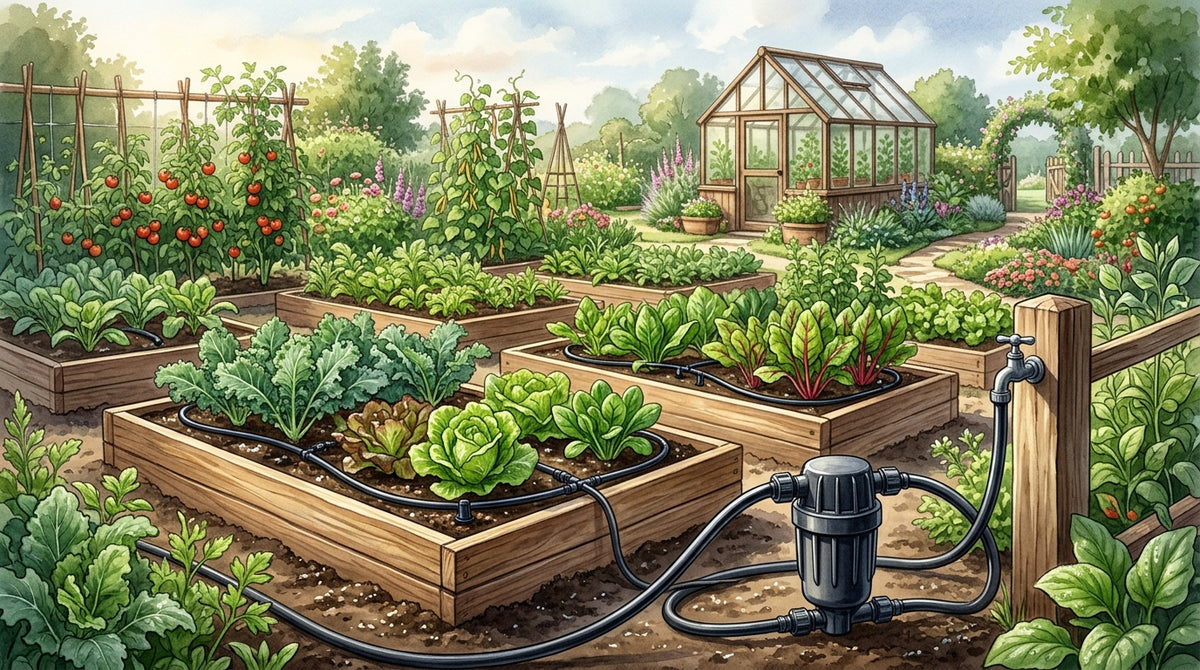
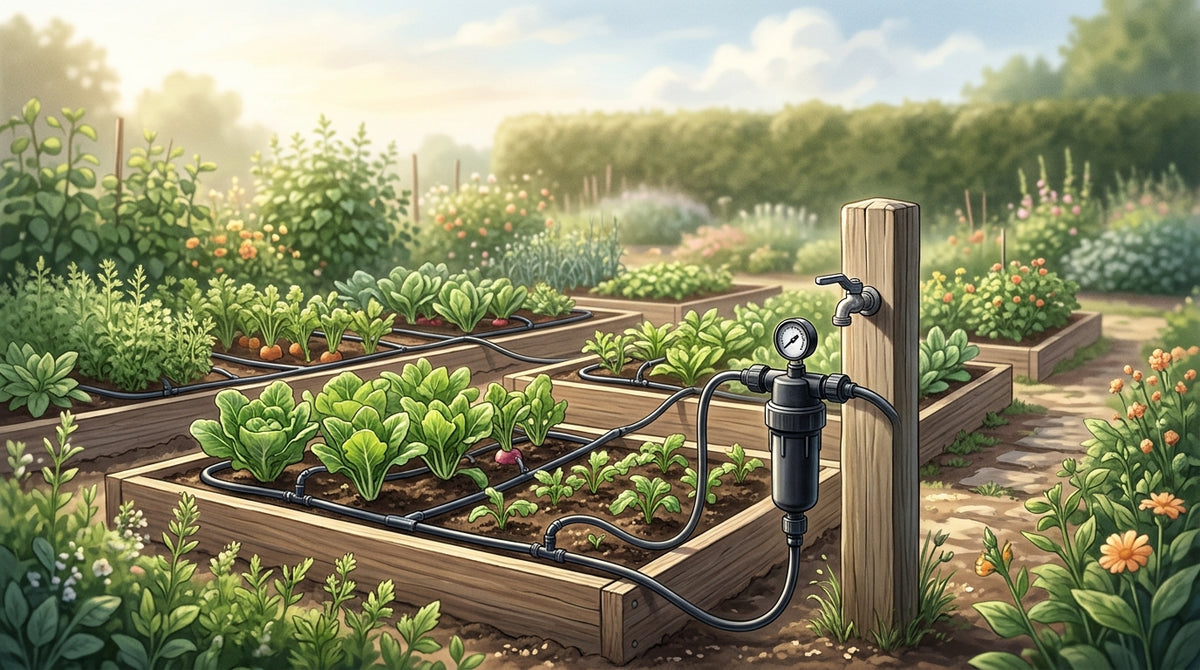
A suitable filter helps manage suspended particles that can clog drip emitters. It supports reliable watering when selected and maintained as part of a properly designed system. The selection process involves matching filtration capacity to four key factors: emitter requirements, actual water quality, total zone demand and your maintenance routine.
Understanding Drip Irrigation Filter Mesh Size and Emitter Requirements
A filter's mesh or micron rating describes its filtration grade. For woven screens, a higher mesh number generally indicates smaller openings, but the opening also depends on the screen construction. Micron ratings describe particle size in micrometers; check how the manufacturer defines and tests that rating. Disc filters may use mesh-equivalent labels. Use the exact product documentation rather than treating every mesh-to-micron chart as interchangeable.
Start by checking your emitter specifications. Use the emitter manufacturer's required filtration grade rather than estimating it from the visible outlet size. Particles may accumulate together, so the size of a single opening does not establish a safe filter specification. For example, a Netafim manual disc filter with 3/4-inch MPT connections rated at 140 mesh is one product example to evaluate against the emitter requirements, water conditions and plumbing dimensions in your garden.
Remember that filtration addresses suspended particles in your water supply. According to research on emitter plugging causes, filtering particles alone does not solve every clogging problem because dissolved minerals can later precipitate as scale inside emitters, and biological growth presents separate challenges. Choose filtration appropriate for your actual water conditions rather than assuming maximum filtration always provides the best solution.
Evaluating Your Water Quality
Assess the actual water reaching your system. Suspended sand, sediment and debris call for different checks from dissolved minerals or biological growth. A source label such as well or municipal supply is not enough to choose a filter.
Surface supplies may contain organic material as well as mineral particles. Consider seasonal changes and inspect what accumulates in your existing filter. Some conditions call for additional treatment or filtration stages, which should follow a water assessment and equipment guidance. Testing your water helps identify whether suspended particles, dissolved minerals or biological factors pose the primary risk to your system.
Screen Filters Versus Disc Filters
Screen filters use a cylindrical mesh element that traps particles as water flows through. Check the screen's rated filtration grade and the manufacturer's inspection and cleaning instructions. Access to the element can help you see what material is accumulating.
Disc filters employ stacked grooved discs compressed together, with particles trapped in the grooves as water passes between discs. The disc filter design uses grooves between compressed discs to form the filtering passages. Compare the exact model's filtration grade, rated capacity and maintenance procedure.
Neither filter type universally outperforms the other across all applications. Compare each candidate filter's stated application, filtration grade and cleaning access. Evaluate its specifications against your actual water conditions instead of choosing solely by filter category. Your specific water quality and maintenance preferences should guide this choice.
Matching Filter Capacity to Zone Demand
Calculate the total flow requirement for your largest irrigation zone by adding all emitter flow rates that operate simultaneously. Your filter must handle this combined demand without creating excessive pressure loss. Check the exact current model documentation before sizing, as specifications vary between manufacturers and product lines.
Undersized filters restrict flow and reduce system pressure, causing uneven water distribution. Compare models using their rated capacity and pressure-loss information, along with the maintenance access and space available in your installation.
Maintenance Considerations and Safety
All filters require periodic cleaning to maintain performance. A manual filter requires operator attention. If considering an automatic model, check how its cleaning cycle is triggered and what flow, pressure and maintenance it requires. Cleaning intervals depend on the equipment and the material accumulating in it.
Always shut off the water supply and relieve system pressure before opening any filter for inspection or cleaning. This safety step prevents injury from pressurized water and allows safe filter element removal.
Practical Buying Checklist
Before purchasing a drip irrigation filter, verify these points:
- Filtration grade meets the exact requirement of every emitter on the zone
- Connection size and type fit your existing system plumbing
- Flow capacity accommodates your largest zone demand
- Filter type suits your water quality and maintenance preferences
- Housing material resists corrosion in your installation environment
- Current product documentation confirms compatibility
Filter selection is one part of maintaining a drip system. Match the filter to emitter specifications, actual water conditions and zone demand, then inspect its performance. This approach helps manage physical blockage without assuming that filtration alone solves scale, biological growth or hydraulic problems.

Leave a comment
This site is protected by hCaptcha and the hCaptcha Privacy Policy and Terms of Service apply.