
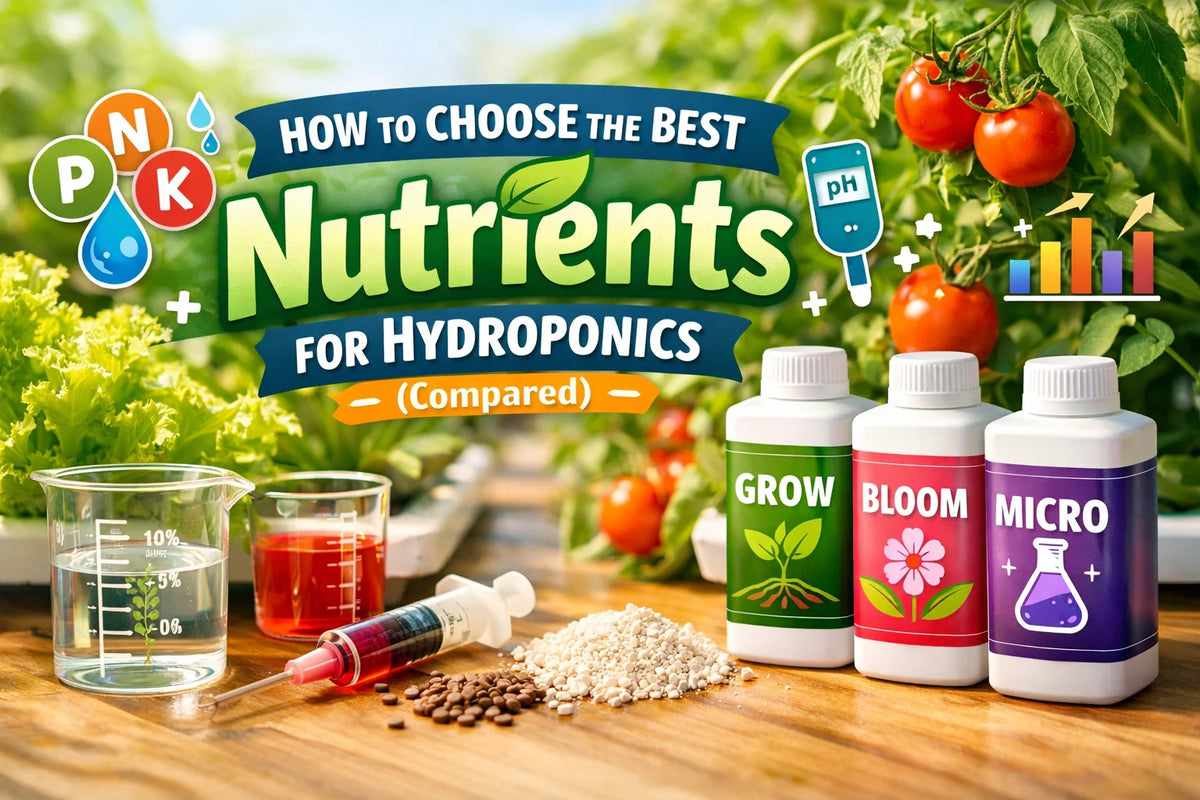
Choosing the best nutrients for hydroponics is often the most overwhelming part of starting an indoor garden. When you walk into a grow shop or browse an online store, you are met with a literal wall of colorful bottles, each claiming to be the "secret sauce" for massive yields.
The reality is that plants don't care about the brand name or the flashy label; they care about the bioavailability of the minerals and the balance of elements in the water. In a hydroponic system, you are the "mother nature" for your plants. Since there is no soil to buffer mistakes or provide trace elements, every single thing your plant needs to grow, breathe, and flower must be dissolved in your reservoir.
In this guide, we’re going to break down how to choose the right nutrient line for your specific setup, compare the major brands we carry at Perfect Gardens, and explain why the water you start with is just as important as the nutrients you add.
The Foundation: Understanding N-P-K and Beyond
Before we look at specific brands, you need to understand the three numbers on every bottle: Nitrogen (N), Phosphorus (P), and Potassium (K).
- Nitrogen (N): Responsible for vegetative growth and green leaves.
- Phosphorus (P): Critical for root development and flower/fruit production.
- Potassium (K): Regulates the plant's internal "plumbing" and overall health.
While N-P-K is the headline, hydroponic plants also require secondary macronutrients (Calcium, Magnesium, Sulfur) and a host of micronutrients (Iron, Manganese, Zinc, etc.). In soil, these are often present in the dirt. In hydro, if they aren’t in the bottle, your plant will eventually show a deficiency.
The Role of Water Quality
One of the biggest mistakes growers make is focusing entirely on the NPK bottles and ignoring their source water. Whether you are using tap water or Reverse Osmosis (RO) water, the chemistry of that water dictates how well your nutrients will work.
Tap water often contains chlorine, chloramines, and heavy metals that can lock out nutrients. On the other hand, RO water is a "blank slate," but it is often chemically unstable and lacks essential trace minerals.

This is where a product like Drops of Balance becomes essential. It isn't a traditional NPK fertilizer; it is a concentrated mineral solution designed to purify and remineralize water. By adding these sulfate-based minerals, you ensure that the water in your reservoir is optimized for nutrient uptake. Many growers find that adding Drops of Balance allows them to use fewer base nutrients because the plants become significantly more efficient at absorbing what is already there.
Comparing Nutrient Systems: 1-Part, 2-Part, or 3-Part?
When searching for the best nutrients for hydroponics, you’ll notice they come in different "parts." This isn't just a marketing gimmick; it’s about chemistry.
1-Part Nutrients (Simple & Effective)
These are single bottles that contain everything. They are ideal for beginners or those who want a low-maintenance setup.
- Pros: Hard to mess up; no complex mixing.
- Cons: Less flexibility to adjust for specific plant needs during different life cycles.
2-Part Nutrients (The Standard)
Usually labeled as "Part A" and "Part B." You cannot mix these together in concentrated form (they will precipitate and turn into solids), which is why they are kept in separate bottles.
- Pros: More stable than 1-part; allows for better concentrations of Calcium and Phosphorus.
- Cons: Requires two bottles; slightly more measuring.
3-Part Nutrients (The Professional Choice)
Systems like the General Hydroponics Flora Series use three bottles (Grow, Bloom, and Micro).
- Pros: Maximum control. You can adjust the ratios as the plant moves from seedling to harvest.
- Cons: High learning curve; easy to overfeed if you aren't following a strict chart.
Comparing the Top Brands at Perfect Gardens
Every grower has different priorities. Some want the cheapest option, while others want the one that requires the least amount of work. Here is how the top brands stack up.
1. General Hydroponics (GH) – The Industry Standard
General Hydroponics has been around since the 70s for a reason. Their Flora Series is perhaps the most documented nutrient line in history. If you have a question about a GH feeding schedule, a thousand people online can answer it.
- Best for: Budget-conscious growers and those who like to follow tried-and-true recipes.
- The Caveat: It requires careful pH monitoring. It does not "self-adjust."
2. Advanced Nutrients – The "Auto-Pilot" Option
Advanced Nutrients is famous for their "pH Perfect" technology. If your source water is within a reasonable range, these nutrients will automatically balance the pH for you.
- Best for: Growers who hate testing pH daily or those looking to maximize terpene and oil production.
- The Caveat: It is one of the more expensive lines on the market.
3. NPK Industries – Raw Customization
If you prefer dry nutrients over liquid, NPK Industries offers "Raw" solubles. These allow you to buy individual elements (like just Nitrogen or just B-Vitamins) to customize your feed.
- Best for: Advanced growers who want to build their own custom nutrient profiles from scratch.
4. Drops of Balance – The Mineral Essential
While not a standalone NPK, we consider this a "must-have" for any serious hydroponic setup. It acts as a bridge between your water and your nutrients. By purifying the water and providing a full spectrum of trace minerals, it prevents the "mystery deficiencies" that plague many hydro growers.

Factors to Consider Before You Buy
Your Grow Medium
Are you growing in Deep Water Culture (DWC), Coco Coir, or Rockwool?
- Coco Coir naturally absorbs Calcium and releases Potassium. If you use Coco, you almost certainly need a "Coco-specific" nutrient or a heavy Calcium-Magnesium (Cal-Mag) supplement.
- DWC/Aeroponics requires very clean, highly soluble nutrients. Avoid organic nutrients that contain thick "sludge" or particles, as they will clog your pumps and air stones.
Your Experience Level
If this is your first grow, do not buy a 12-bottle "expert" bundle. Start with a solid base nutrient (like a 2-part system) and perhaps a microbial inoculant. As you see how the plants respond, you can start adding "bloom boosters" or enzyme cleaners.
Check out our nutrient packages for pre-balanced kits that take the guesswork out of the equation.
pH Management
In hydroponics, pH is the "gatekeeper." If your pH is too high or too low, the plant literally cannot "see" the nutrients in the water, even if they are there in abundance. This is called nutrient lockout.
- If you don't want to check pH every day, look for "pH Perfect" or "pH Buffered" formulas.
- If you are on a budget, invest in a high-quality pH pen and a "pH Up and Down" kit.
The Importance of Microbes in Hydroponics
A common misconception is that hydroponics must be "sterile." While some growers use bleach or peroxide to keep their reservoirs clean, many of the most successful growers use "beneficial microbes."
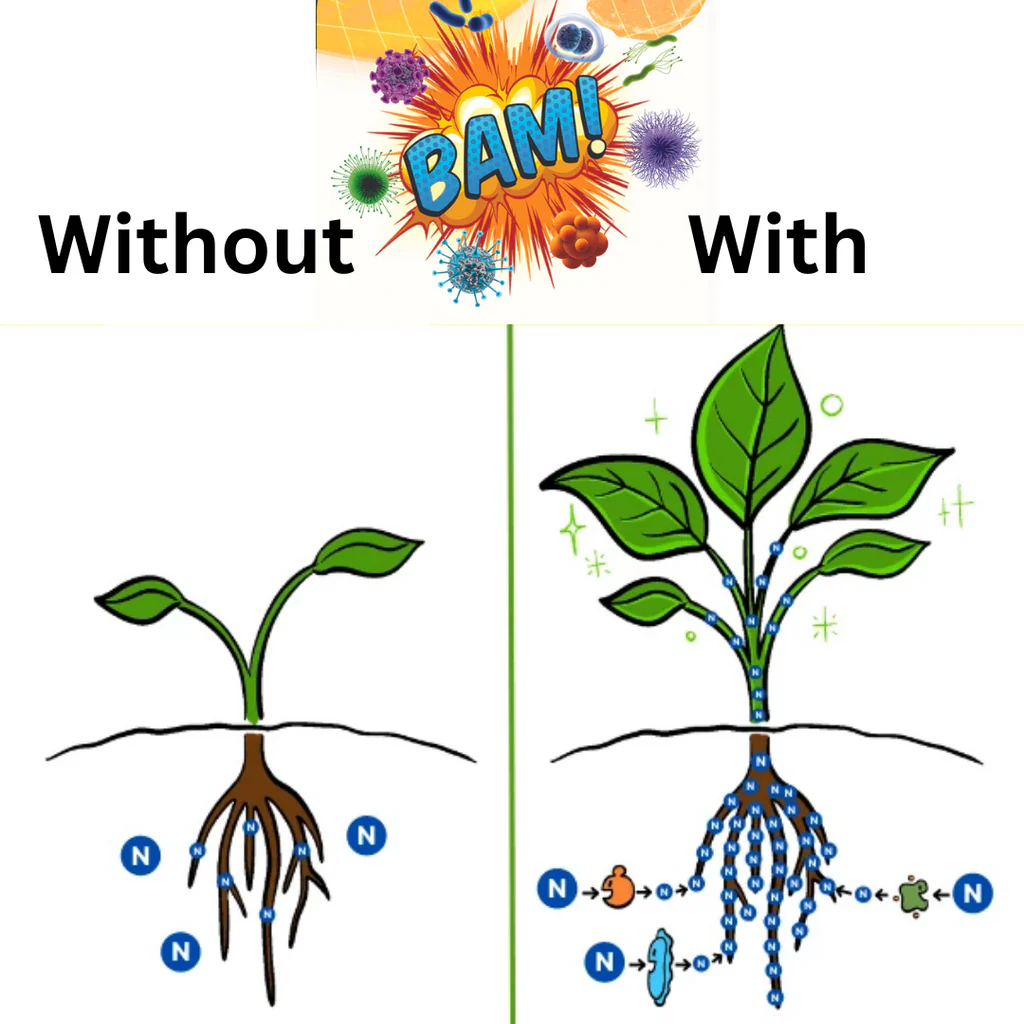
Adding a microbial inoculant helps break down organic matter and protects the roots from pathogens like Pythium (Root Rot). When combined with a mineral supplement like Drops of Balance, you create an environment where the roots can thrive without the risk of rot.
Decision Workflow: Which One Should You Pick?
- I want the absolute simplest setup: Go with a high-quality 1-part liquid nutrient and use tap water treated with Drops of Balance.
- I want the biggest yields and don't care about cost: Go with the Advanced Nutrients "pH Perfect" line and add a microbial tea.
- I am on a tight budget: Use the General Hydroponics Flora Series (3-part). It’s concentrated and lasts a long time.
- I am using RO water: You must add a mineralizer or a Cal-Mag supplement. We recommend starting with Drops of Balance to stabilize the water before adding your base nutrients.
Caution: The "More is Better" Trap
The fastest way to kill a hydroponic garden is by overfeeding. Most nutrient manufacturers' feed charts are "aggressive." They are designed to show you what the plant can handle under perfect conditions (high light, high CO2).
If you are a hobbyist grower, we always recommend starting at 50% strength of what the bottle recommends. It is much easier to fix a slight deficiency than it is to flush out a toxic overabundance of minerals that has burnt your roots.
Final Thoughts
The "best" nutrients for hydroponics are the ones that fit your lifestyle and your specific water chemistry. There is no magic bottle that replaces good gardening practices. Focus on keeping your reservoir temperatures cool, your pH stable, and your water oxygenated.
If you get those basics right and choose a reputable brand from our collections, your plants will do the rest of the work for you.
Ready to get started? Explore our full range of plant nutrients and find the perfect match for your garden today.


Leave a comment
This site is protected by hCaptcha and the hCaptcha Privacy Policy and Terms of Service apply.