
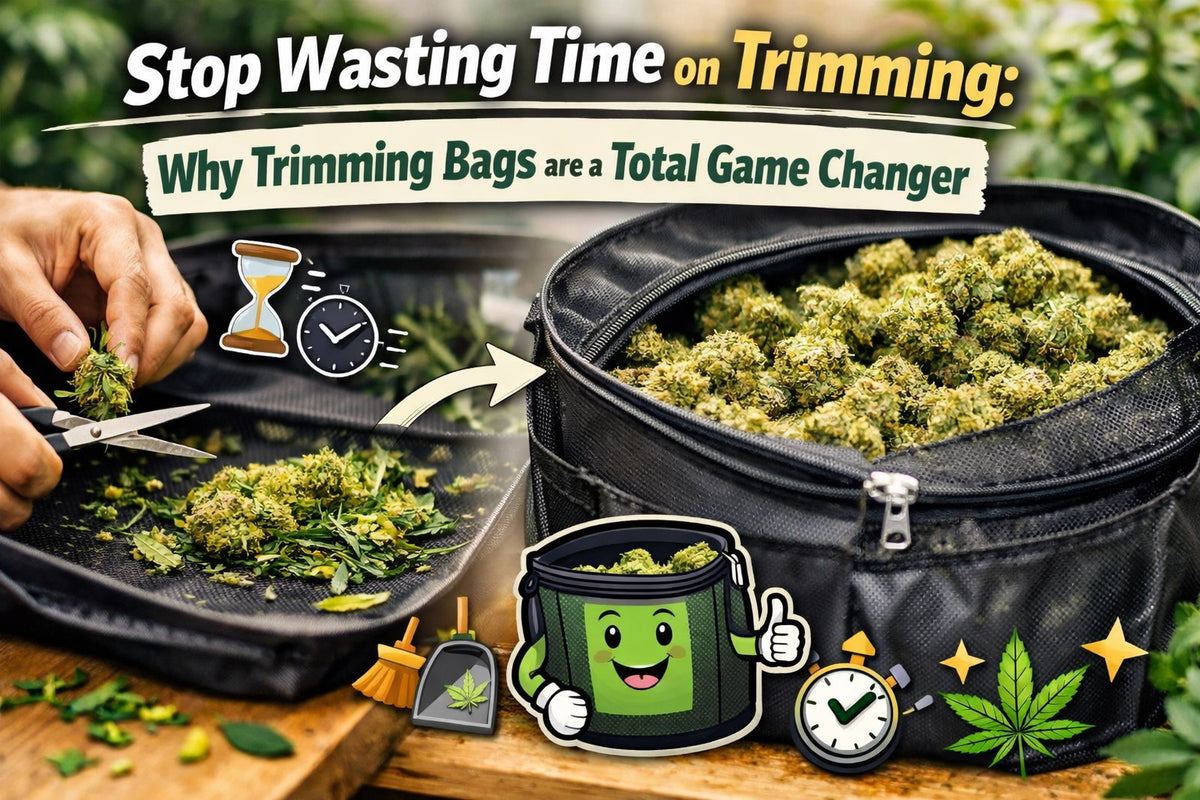
Ask any experienced grower what their least favorite part of the job is, and you’ll get the same answer nine times out of ten: "Trimming jail."
You know the feeling. You’ve spent months checking pH levels, dialing in your grow lights, and watching your plants thrive. The harvest is finally here, and the excitement is through the roof: until you realize you have ten pounds of flower sitting in front of you and only two hands to process it.
Hand-trimming is a labor of love, but for most of us, it’s just labor. It’s slow, it’s messy, and it’s a massive bottleneck that can take a hobbyist an entire weekend or a commercial grower a week of paid labor. This is where trimming bags come in. If you’re still sitting at a table with a pair of sticky scissors for 12 hours straight, you’re working harder, not smarter.
The Math of the Harvest: Why Manual Trimming is Killing Your Productivity
Let’s look at the cold, hard facts. An average, experienced hand-trimmer can process roughly one pound of dry flower in an eight-hour shift. If you have a decent-sized harvest, you’re looking at days of isolation.
When you use a high-quality trimming bag, those same quantities can be processed in a fraction of the time. We aren’t talking about saving twenty minutes; we’re talking about cutting a three-day job down to three hours. Research shows that specialized mesh tumbler systems and trimming bags can process material at a rate that allows growers to finish an entire weekend's worth of work before lunch.
The fact of the matter is that your time has a dollar value. Whether you’re paying yourself or a crew, the efficiency gain from a trimming bag usually pays for the bag itself within the first few hours of use.

How Trimming Bags Actually Work (It’s Not Magic, It’s Physics)
A lot of growers are skeptical at first. They think, "How can a bag do what my expensive titanium scissors do?"
The secret is in the friction and the mesh. A trimming bag is essentially a specialized container with a specific micron-rated mesh lining. You place your dried, bucked material (the buds removed from the main stems) into the bag and use a specific "tumble and shake" motion.
As the material moves around, the dry, brittle leaves (the "sugar leaves") catch on the mesh. The friction causes these leaves to snap off cleanly, while the more resilient, denser flower remains intact. The excess leaf material then sifts through the mesh into a collection chamber, leaving you with trimmed flower and high-quality trim for extraction.
It’s a "blade-free" operation. Unlike motorized trimmers that use rotating blades (which can sometimes "shave" the buds and leave them looking like they went through a pencil sharpener), a trimming bag preserves the natural shape of the flower.
Preservation of Trichomes: Addressing the Elephant in the Room
The biggest misconception about trimming bags is that they "knock all the crystals off."
Let’s be real: any time you touch a bud, you are losing a tiny bit of resin. This happens with hand-trimming too: just look at your scissors and your gloves at the end of the day. That’s all "lost" product.
However, a trimming bag is often gentler than a human hand. Think about it: a hand-trimmer is constantly grabbing, flipping, and poking the bud with metal blades. In a bag, the buds are mostly bumping into each other and a soft mesh. Because the process is so much faster, the flower is actually being handled for less time overall.
Plus, any "loss" isn't really lost. The trichomes that do fall off are collected in the bottom of the bag along with the trim. You can easily turn that into hash or edibles. If you’re looking for more info on post-harvest processing, check out our grow help videos for a deep dive.

Caption: A close-up side-by-side comparison of a hand-trimmed bud versus a bag-trimmed bud, showing the preserved structure and resin.
Step-by-Step: How to Use a Trimming Bag Like a Pro
To get the best results, you can’t just throw wet plants into a bag and hope for the best. There is a technique to it.
1. The Dry is Everything
This is the most important rule: Only bag-trim dry material. If your leaves are still "bendy" or moist, they won't snap off. They will just get squished against the mesh. Your material should be dry enough that the stems "snap" rather than bend.
2. Bucking the Material
Remove the buds from the main large stalks. You want individual "nuggets" in the bag, not long branches. This allows the material to tumble freely.
3. Don't Overfill
It’s tempting to stuff the bag to the brim to save time, but the buds need room to move. Generally, you want to fill the bag about 1/3 to 1/2 full. Overfilling leads to an uneven trim and requires more "shaking" time, which can beat up the flower.
4. The Motion
It’s a combination of a rotating "tumble" and a light "sifting" shake. Usually, 30 to 60 seconds of movement is all it takes. Every 15 seconds, give it a quick check. It’s better to do two short cycles than one long one and over-trim.
5. The Finish
Dump the buds out. You might find a few "crow's feet" or a stubborn leaf here and there on the "tops" (the biggest, most beautiful buds). You can quickly touch those up with scissors, but 95% of the work is already done.
Comparing the Options: Hand vs. Machine vs. Bag
| Feature | Hand Trimming | Motorized Trimmers | Trimming Bags |
|---|---|---|---|
| Speed | Very Slow | Extremely Fast | Very Fast |
| Cost | High (Labor) | Very High ($500 - $5,000+) | Low ($100 - $300) |
| Quality | Highest/Artisanal | Medium (Can be "shaved") | High (Natural shape) |
| Maintenance | Cleaning scissors | Heavy cleaning/Blades | Simple rinse/shake |
| Portability | N/A | Low (Heavy/Needs Power) | High (Collapsible) |
For most home growers and mid-sized operations, the trimming bag is the "Goldilocks" solution. It’s faster than hands but cheaper and more portable than a $3,000 motorized machine. If you are looking to automate more of your setup, you might also be interested in our guide on automation tools that cut your work in half.
Post-Trim: Keeping the Quality High
Once the bag has done its job, the work isn't quite over. Because the trimming bag relies on the material being dry, your buds are at the perfect stage to start the curing process.
One mistake people make is leaving the trimmed buds out in the open air for too long after the bag session. Once those protective sugar leaves are gone, the flower can dry out very quickly. We recommend moving your trimmed flower immediately into airtight glass jars or curing bins.
To ensure you don’t lose that precious terpene profile, use a humidity control pack. It keeps the environment inside the container at a steady 62%, which is the "sweet spot" for long-term storage and flavor development.

Caution: When a Trimming Bag Might Not Be for You
While we love these tools, they aren't for everyone. If you are growing a very small amount: say, one or two plants: the time it takes to set up the bag and clean it might not be worth it compared to just sitting down with scissors for an hour.
Also, if you are growing "competition-grade" flower where every single trichome head needs to be perfectly intact for a macro-photography shoot, hand-trimming is still the gold standard. A bag is a tool for efficiency and scale. It’s for the grower who wants to enjoy their harvest rather than spend their entire life processing it.
Final Thoughts
The transition from hand-trimming to using a trimming bag is one of those "wish I did this years ago" moments. It changes the entire vibe of the harvest. Instead of a looming mountain of work, it becomes a quick, satisfying task.
At Perfect Gardens, we’re all about helping you get better yields with less stress. Whether you’re looking for a Bubble Magic Dry Trimming Bag or just need some advice on soil health, we’ve got your back. Stop wasting your weekends and start using tools that work as hard as you do.

Caption: A happy grower holding a collapsible trimming bag, showing how it fits into a small storage space when not in use.
If you have questions about which harvesting tools are right for your specific tent size or plant count, don't hesitate to reach out to us through our contact page. Happy harvesting!



Leave a comment
This site is protected by hCaptcha and the hCaptcha Privacy Policy and Terms of Service apply.