
Blog
Choosing the Best LED Grow Lights: Understanding PPFD and Efficacy
Let’s be real for a second, trying to buy grow lights in 2026 feels a lot like trying to buy a high-end gaming laptop or a new car. You are immediately hit with a wall of acronyms, numbers, and marketing "specs" that sound impressive but don’t always tell you if your plants are actually going to grow.
If you’re setting up an indoor gardening setup, you’ve probably seen terms like PPFD, PAR, and Efficacy thrown around like candy. But what do they actually mean for your harvest? Are you paying for light that your plants can’t even use, or are you starving them of the energy they need to produce those heavy yields?
At Perfect Gardens, we believe that education is the best nutrient you can give your garden. Let’s break down the science of LED lighting so you can stop guessing and start growing.
What is PAR, Anyway?
Before we dive into the "D" and the "F," we have to talk about PAR (Photosynthetic Active Radiation). PAR isn't a measurement like an inch or a gallon; it’s a description of the type of light.
Humans see light in lumens: this tells us how "bright" a room looks to our eyes. But plants don't care about lumens. They care about the specific wavelengths of light between 400 and 700 nanometers. This is the range that drives photosynthesis. When you look at an LED lights collection, you’re looking for fixtures designed to maximize output in this PAR range.
PPF vs. PPFD: The Faucet and the Glass
This is where most growers get tripped up. Manufacturers often list both, and it’s easy to confuse them.
1. PPF (Photosynthetic Photon Flux)
Think of PPF as the "faucet." It measures the total amount of PAR light that a fixture produces per second. It’s measured in micromoles per second (μmol/s). This tells you how powerful the light is "at the source."
2. PPFD (Photosynthetic Photon Flux Density)
Think of PPFD as the "glass of water." It measures how much of that light is actually landing on a specific spot on your plant's canopy. It’s measured in micromoles per square meter per second (μmol/m²/s).
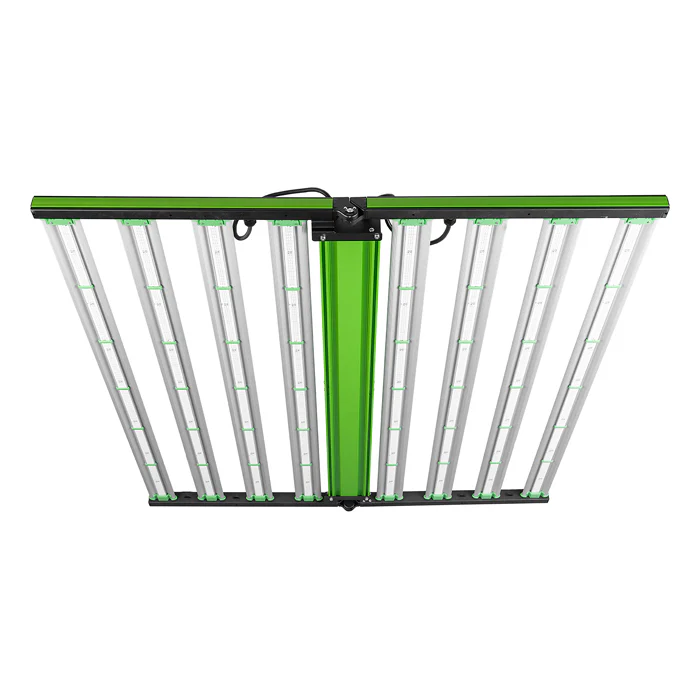
The fact of the matter is that a light can have a massive PPF (total power), but if the light isn't distributed well, your PPFD (what the plant gets) will be high in the center and basically zero in the corners. This is why "bar-style" LEDs have become the standard for professional grows: they spread that light out evenly.
Why Efficacy (µmol/J) is Your Best Friend
In the world of indoor gardening setups, "Efficacy" is the buzzword that actually matters for your wallet. Efficacy measures how efficient a grow light is at converting electricity into usable PAR light. It is expressed as micromoles per Joule (µmol/J).
Back in the day, an efficacy of 1.5 µmol/J was considered decent. In 2026, the industry standard has shifted. High-end fixtures like the Kind LED series or the HLG Blackbird are pushing 2.8 µmol/J and higher.
Why should you care?
- Lower Power Bills: A more efficient light gives you more "growth energy" for every dollar you spend on electricity.
- Less Heat: Energy that isn't turned into light is turned into heat. A light with low efficacy is basically a space heater that happens to glow. High efficacy means your tents stay cooler, and your HVAC system doesn't have to work as hard.
Reading a PPFD Map: Don’t Get Fooled by the Center
When you’re shopping for grow lights, always look for a PPFD map (sometimes called a PAR map). This is a grid that shows the light intensity at different points in a 4x4 or 5x5 area.
A lot of cheaper brands will boast a "PPFD of 1500!" but if you look at their map, that 1500 is only in a tiny 2-inch square directly under the center of the light. Ten inches to the left, the number might drop to 200. That’s how you end up with plants that are burnt in the middle and stretching for light on the sides.
You want a map that shows "uniformity." A great light will provide a consistent PPFD across the entire footprint. For most flowering plants, you’re looking for a PPFD between 600 and 900 µmol/m²/s. If you go higher than 1000, you’ll likely need to supplement with CO2 to help the plant actually process that much energy.

2026 Standards: Tunable Spectrums and Wireless Control
As we move further into 2026, the "all-on or all-off" lights are becoming a thing of the past. Professional and hobbyist setups are moving toward wireless control and tunable spectrums.
Take the Spectrum-Y Wireless LED, for example. These fixtures allow you to adjust the "recipe" of the light. You might want more blue light during the vegetative stage to keep plants short and bushy, then crank up the red and far-red during the flowering stage to encourage big, dense buds.

Maximizing Your Light with Reflection
Even the best light in the world loses its effectiveness if the walls of your grow room are absorbing the photons. This is a common mistake in DIY indoor gardening setups. People paint their walls white and think it's enough.
While flat white paint is okay, professional-grade materials like Panda Film are designed specifically to bounce PAR light back onto the canopy from the sides. This "cross-lighting" ensures that the lower branches of your plants get enough energy to develop, rather than just becoming "larf" (wispy, underdeveloped buds).

Factors to Consider Before You Buy
Before you hit "checkout" on that shiny new light, ask yourself these three questions:
1. What is my ceiling height?
Some high-intensity LEDs are so powerful they can bleach your plants if they are too close. If you are growing in a short tent, look for "bar" style lights or fixtures with lower-wattage diodes that can be hung closer to the canopy.
2. Is my environment controlled?
If you’re moving from older HPS (High-Pressure Sodium) lights to LEDs, remember that LEDs produce much less radiant heat. Your plants might actually get "cold" because the leaves aren't being warmed by the infrared light of the old bulbs. You might need to adjust your controllers to keep the room a few degrees warmer than you're used to.
3. What is my goal?
If you are just doing clones or seedlings, you don't need a 1000W monster. A simple propagation light is more than enough. Over-lighting young plants is one of the quickest ways to stunt their growth.
Common Pitfalls to Avoid
- The "Blurple" Trap: Be cautious of extremely cheap lights that glow bright purple. While plants use red and blue light, modern research shows that "Full Spectrum" white light (which includes greens and yellows) actually penetrates the canopy better and leads to healthier plants.
- Ignoring the Warranty: LED diodes eventually dim over time. A quality manufacturer will stand by their product for 3 to 5 years. If the light doesn't have a solid warranty, it’s likely using sub-par drivers or diodes that will fail within a year.
- Forgetting the Footprint: A light rated for a 3x3 area will not work in a 5x5 tent. You will end up with "dead zones" where nothing grows. Always match the light's rated footprint to your actual growing space.
Final Thoughts
Choosing the right grow lights for your indoor gardening setup doesn’t have to be a headache. Just remember: PPF is what the light puts out, PPFD is what your plant actually eats, and Efficacy is how much it costs you to run.
If you focus on finding a fixture with a uniform PPFD map and a high µmol/J rating, you’re already ahead of 90% of the growers out there. Whether you are looking for commercial-grade bars or something for a small home tent, investing in quality lighting is the single most impactful choice you can make for your garden's success.
Still not sure which light fits your specific tent size? Check out our Grow Help section for more deep dives into specific equipment setups. Happy growing!