
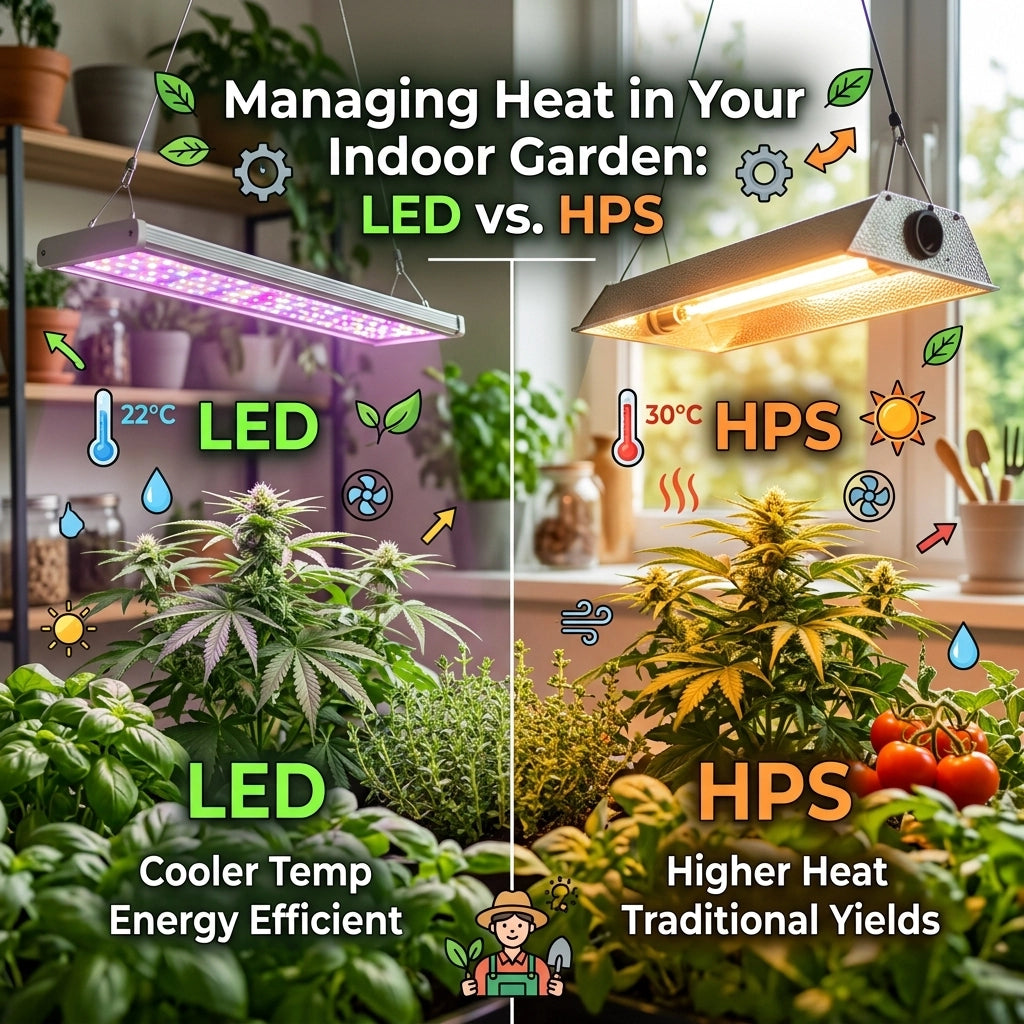
If you’ve been growing indoors for more than a week, you already know that heat is the silent yield-killer. It’s the variable that keeps growers up at night, staring at their hygrometers and wondering if their AC can handle another mid-July afternoon. In the world of indoor gardening, your lighting choice is the single biggest factor determining how much heat you have to manage.
For decades, High-Pressure Sodium (HPS) was the undisputed king of the grow room. But things have changed. Light Emitting Diodes (LEDs) have moved from "expensive toys" to the industry standard. The primary reason? Heat. Or rather, the lack of it.
The fact of the matter is that managing heat isn’t just about keeping your plants from wilting; it’s about maintaining the right Vapor Pressure Deficit (VPD) so your plants can actually breathe and eat. Let’s dive into the physics of why these lights perform so differently and how you can manage the climate in your Perfect Gardens setup.
The Physics of Heat: Radiant vs. Convective
To understand the difference between LED and HPS, we have to look at how they release energy. All lights produce heat: there’s no getting around the laws of thermodynamics. However, they release that heat in very different ways.
HPS: The Space Heater Effect
HPS bulbs are essentially glass tubes filled with pressurized gas and metal salts. To create light, they get incredibly hot. About 55% of the energy consumed by an HPS bulb is released as radiant heat. This is infrared energy that travels in waves and heats up whatever it hits: namely, your plant canopy.
This is why you can’t put an HPS light too close to your plants. Even if the room temperature is a comfortable 75°F, the "leaf surface temperature" (LST) directly under an HPS bulb could be 85°F or higher. It’s like standing under the sun on a summer day; the air might be cool, but your skin feels the burn.
LED: The Efficiency King
LEDs, like those from MEDIC GROW or KIND LED, operate differently. They only emit about 27% of their energy as radiant heat. The rest of the heat they produce is convective heat, which is generated at the back of the diode and pulled away by heat sinks.
Because the heat is moved away from the plants and into the air above the light fixture, the plant canopy stays much cooler. This allows you to bring the lights closer to the plants (depending on the intensity) without bleaching them or causing heat stress.
Why Efficiency Matters for Your Wallet
When we talk about efficiency, we aren’t just talking about your electric bill: though that’s a big part of it. We are talking about the total "heat load" of your room.
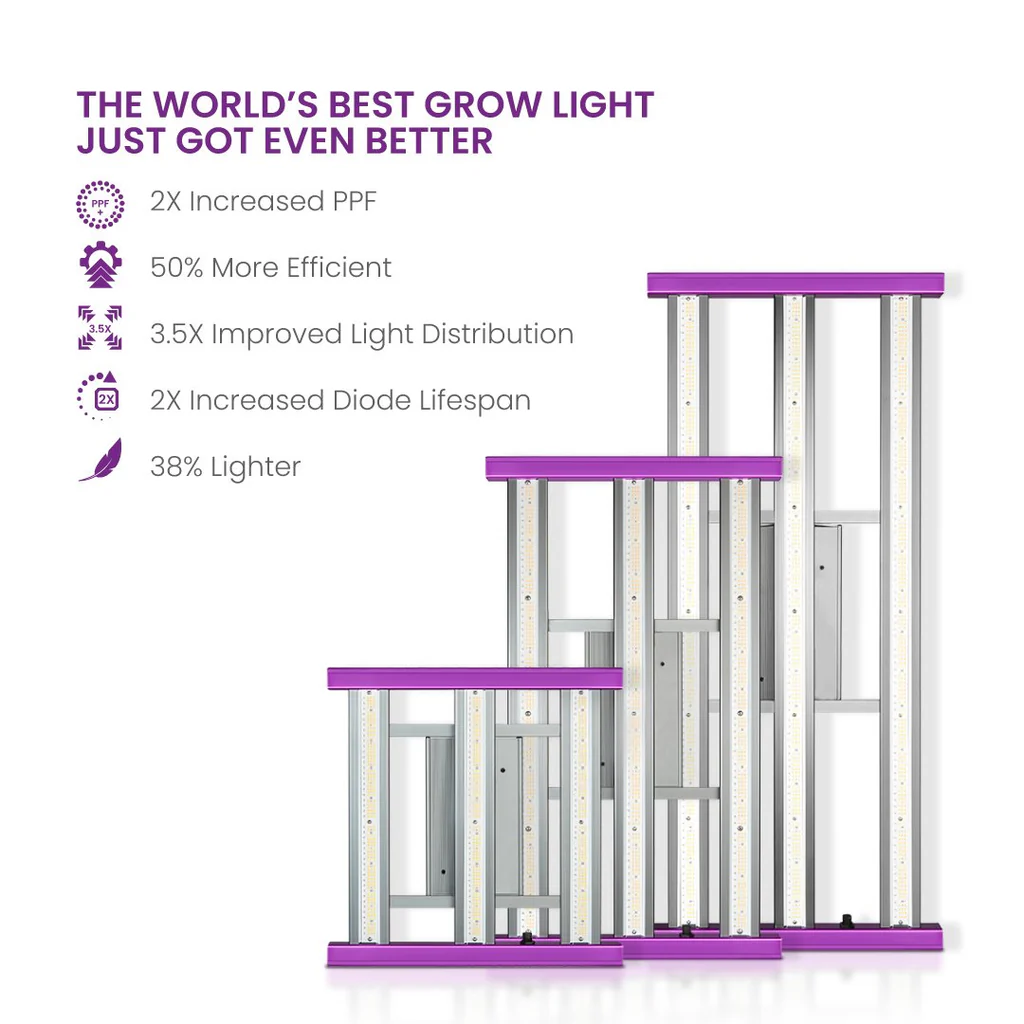
- Lower AC Costs: For every watt of HPS lighting you run, you often need an equal or greater amount of energy spent on cooling. By switching to a high-efficiency LED like the Spectrum-Y Wireless LED, you drastically reduce the BTU requirements of your air conditioning system.
- Less Water Usage: Hotter plants transpire more to stay cool. If your room is baking under HPS lights, your plants are drinking purely for survival, not necessarily for growth. Cooler LED environments lead to more controlled water and nutrient uptake.
- Longer Equipment Life: Fans, filters, and AC units all have to work twice as hard to combat HPS heat. Reducing the heat load extends the life of your entire grow essentials kit.
Managing the Climate: Strategies for Success
Whether you are sticking with HPS or making the jump to LED, you need a plan for ventilation. It seems more like a simple task: just put a fan in the window: but it’s actually a bit more technical than that.
1. Ventilation and Extraction
You need to replace the air in your grow space frequently. For a standard grow tent, we recommend an extraction kit that can cycle the entire volume of air every 1–3 minutes.
If you are running HPS, you almost certainly need air-cooled hoods. These allow you to pull air through the light fixture itself and vent it outside without that heat ever touching your plants. With LEDs, you don't need air-cooled hoods, but you still need a strong extraction kit to remove humidity and the convective heat that rises to the top of the tent.

2. The Importance of Airflow
Never underestimate the power of oscillating fans. Heat tends to "stratify," meaning it sits in layers. In an LED room, the air at the top of the tent might be 10 degrees warmer than the air at the floor. Oscillating fans break up these micro-climates and ensure that the CO2-rich air is reaching the leaves.
3. Understanding LST and VPD
This is where many growers get tripped up when switching to LED. Because LEDs don't emit much radiant heat, your leaf surface temperature will be lower. If you keep your room at 75°F (which is great for HPS), your plants might actually be too cold under LEDs to maintain a high metabolic rate.
Pro-Tip: When using LEDs, most growers find that raising the ambient room temperature to 80-82°F actually helps the plants perform better, as it brings the leaf temperature into the "sweet spot" for transpiration.

When HPS Might Actually Be Better
It’s not often we say this in 2026, but there are scenarios where HPS still has an edge. The fact of the matter is that heat is sometimes your friend.
If you are growing in a cold climate: say, a basement in Maine or a garage in Canada during the winter: the heat from an HPS light acts as a free heater. If you switched to LEDs in those conditions, you would likely have to buy an electric space heater to keep the room warm enough for the plants to grow. In this specific case, the "inefficiency" of the HPS bulb is actually serving a dual purpose.
However, for 90% of indoor growers, especially those in warmer climates or those looking to maximize their hydroponics setup, LED is the clear winner for heat management.
Choosing the Right LED for Heat Management
Not all LEDs are created equal. Some cheap "blurple" lights on the market use inefficient drivers that get just as hot as HPS without the light output to back it up.
When looking for a light that manages heat well, look for:
- Passive Cooling: Large aluminum heat sinks that dissipate heat without needing noisy internal fans.
- High Efficacy: Look for lights with at least 2.7 µmol/j. The more efficient the light is at turning electricity into photons, the less energy is "wasted" as heat.
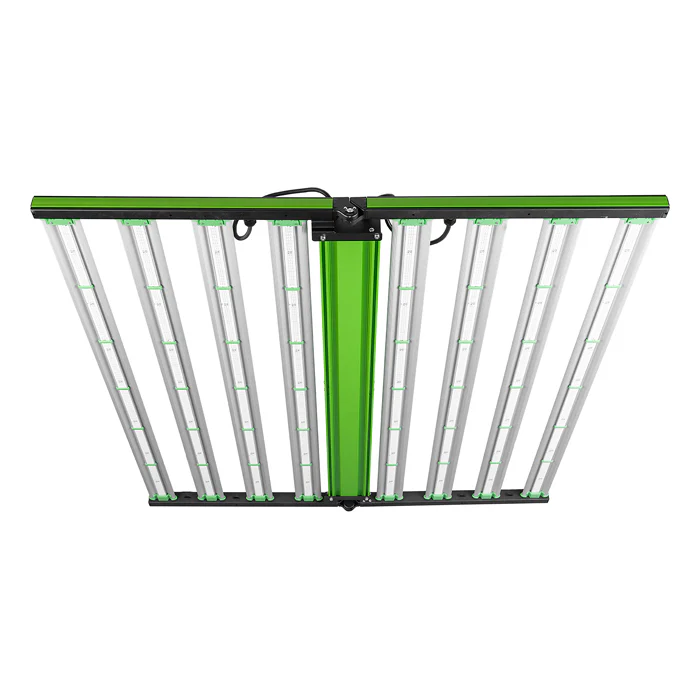
- Removable Drivers: Brands like MEDIC GROW often design their lights so the driver (the part that gets the hottest) can be unmounted and placed outside the grow tent. This is a game-changer for summer growing.
Caution: Common Pitfalls
- The "Sealed Room" Trap: Don't think that just because you have LEDs, you can seal your room completely. Plants still need fresh CO2 and a way to exhaust humidity. Without ventilation, even an LED room will eventually turn into a swampy sauna.
- Over-Cooling: Be careful not to blast your plants with an AC unit directly. Cold air hitting a warm leaf can cause stress and stunt growth. Always aim for a consistent, ambient temperature.
- Ignoring Humidity: As heat goes down, relative humidity often goes up. Keep an eye on your controllers to ensure you aren't trading a heat problem for a mold problem.
Final Thoughts
Managing heat is one of the biggest hurdles to achieving a "Perfect Garden." While HPS lights are a reliable, old-school technology that can help in freezing environments, the modern grower is almost always better off with the efficiency of LED.
By choosing high-quality fixtures and pairing them with a solid extraction kit and grow tent, you take the guesswork out of climate control. You’ll spend less time stressing over the thermostat and more time watching your plants thrive.
If you’re ready to upgrade your lighting or need help sizing a ventilation system for your specific space, check out our featured products or reach out to us for some grow help. We've seen every heat issue under the sun (and the HPS), and we're here to help you dial it in.


Leave a comment
This site is protected by hCaptcha and the hCaptcha Privacy Policy and Terms of Service apply.