
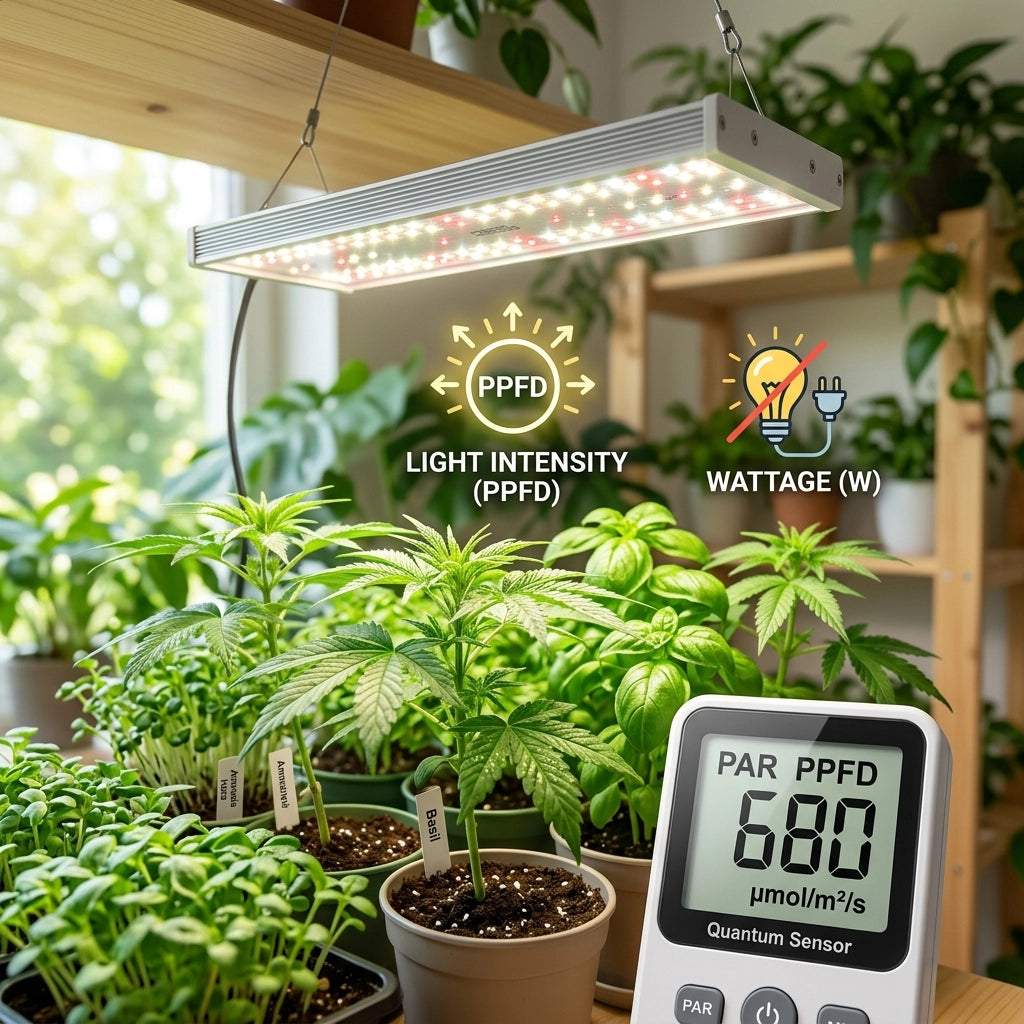
For a long time in the world of indoor gardening, "wattage" was the king of metrics. If you wanted a bigger yield, you bought a light with a higher wattage. It was a simple, albeit flawed, way of thinking. You’d walk into a shop, grab a 1000W Double Ended HPS, and know exactly what you were getting. But as the industry has shifted toward LED technology, that old rule of thumb has completely fallen apart.
The fact of the matter is that wattage tells you how much electricity a light pulls from your wall, but it tells you almost nothing about how much of that energy is actually being converted into light that your plants can use. If you are still buying lights based on wattage alone, you are likely overpaying for electricity and under-delivering on harvest quality.
In this guide, we’re going to break down why Photosynthetic Photon Flux Density (PPFD) is the only metric that truly matters when you’re trying to maximize your LED lights setup.
The Problem with the "Wattage" Metric
When we talk about wattage, we are talking about power consumption. In the days of HID (High-Intensity Discharge) lighting, wattage was a decent proxy for intensity because the technology was relatively standardized. A 600W HPS from one brand performed very similarly to a 600W HPS from another.
With LEDs, the game has changed. You can have a 600W LED fixture that performs significantly worse than a high-quality 400W LED fixture. This happens because of efficacy: the measure of how efficiently a light converts those watts into usable photons.
Think of it like two different cars. One car might have a massive V8 engine that gulps down gas (high wattage) but struggles to hit 60 mph. Another car might have a highly tuned turbocharged engine that uses half the fuel (low wattage) but leaves the first car in the dust. In the grow room, we want the "miles per gallon" for our plants, and that is measured in micromoles per joule ($\mu$mol/j).

Understanding the "Big Three": PPF, PPFD, and DLI
To understand why wattage is misleading, we have to look at how we actually measure plant light. There are three main acronyms you’ll see on any reputable grow essentials spec sheet: PPF, PPFD, and DLI.
1. PPF (Photosynthetic Photon Flux)
PPF measures the total amount of light (photons) that a fixture emits every second. It’s measured in micromoles per second ($\mu$mol/s). This tells you the total "output" of the light, but it doesn't tell you where that light is going or if it's actually reaching your canopy.
2. PPFD (Photosynthetic Photon Flux Density)
This is the metric you should live and die by. PPFD measures how many of those photons are actually landing on a specific spot on your plant's leaves. It’s measured in micromoles per square meter per second ($\mu$mol/m²/s).
If PPF is the total amount of rain falling from a cloud, PPFD is the amount of rain landing in a single bucket on the ground. As a grower, your "bucket" is your plant canopy. You need to know that the density of light is high enough to drive photosynthesis without being so high that it causes light burn.
3. DLI (Daily Light Integral)
DLI is the "big picture." It measures the total amount of light your plant receives over a full 24-hour period. You can achieve a high DLI by having a moderate PPFD for a long period (like 18 hours for vegetative growth) or a high PPFD for a shorter period (12 hours for flowering).
Why PPFD Varies Across Your Tent
One of the biggest misconceptions beginners have is that the PPFD is the same everywhere under the light. This is not the case. PPFD is highest directly under the center of the light and drops off significantly as you move toward the edges of your tents.
This is why "light maps" provided by manufacturers are so important. A light might claim a PPFD of 1000 $\mu$mol/m²/s, but if that’s only in a 6-inch circle in the middle, and it drops to 200 at the edges, your plants on the perimeter are going to struggle.
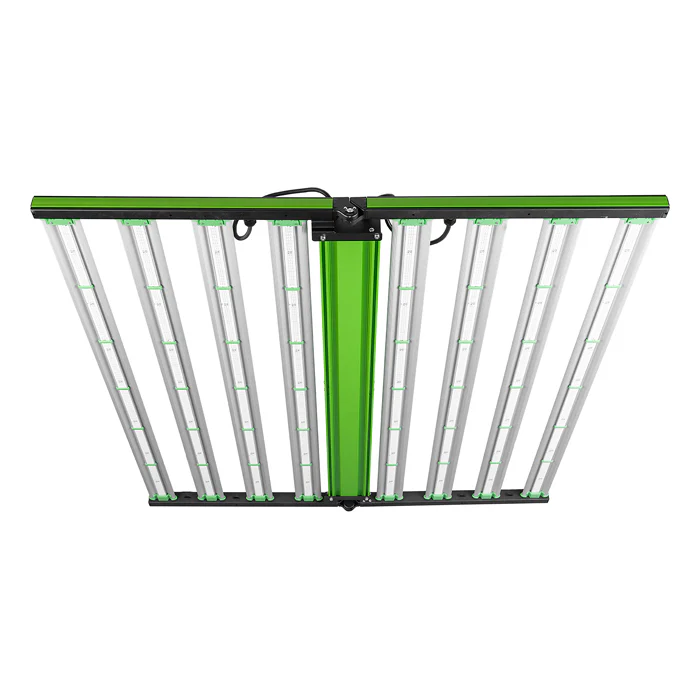
Commercial-grade fixtures like this one often use multiple bars to spread the light more evenly, ensuring the PPFD is consistent from corner to corner.
Factors that influence your PPFD:
- Hanging Height: The closer the light, the higher the PPFD (but the smaller the coverage area).
- Reflective Surfaces: Using high-quality Panda Film on your walls can help bounce "stray" photons back onto the canopy, increasing PPFD at the edges by up to 20-30%.
- Diode Quality: Higher-end chips (like those from Samsung or Osram) generally have better efficacy, meaning they produce more PPFD per watt consumed.

Don't underestimate the power of reflection. Reflective film ensures those expensive photons don't go to waste against a dark wall.
The Hierarchy of Metrics: What to Look For
If you’re shopping for a new light, here is the order of importance you should follow:
- PPFD Map: Does it provide enough intensity for your specific footprint (e.g., 4x4 or 5x5)?
- Efficacy ($\mu$mol/j): How much light are you getting for every dollar spent on electricity? Look for anything above 2.5 $\mu$mol/j.
- PPF: What is the total output capacity?
- Wattage: Only use this to figure out if your circuit breaker can handle the load.
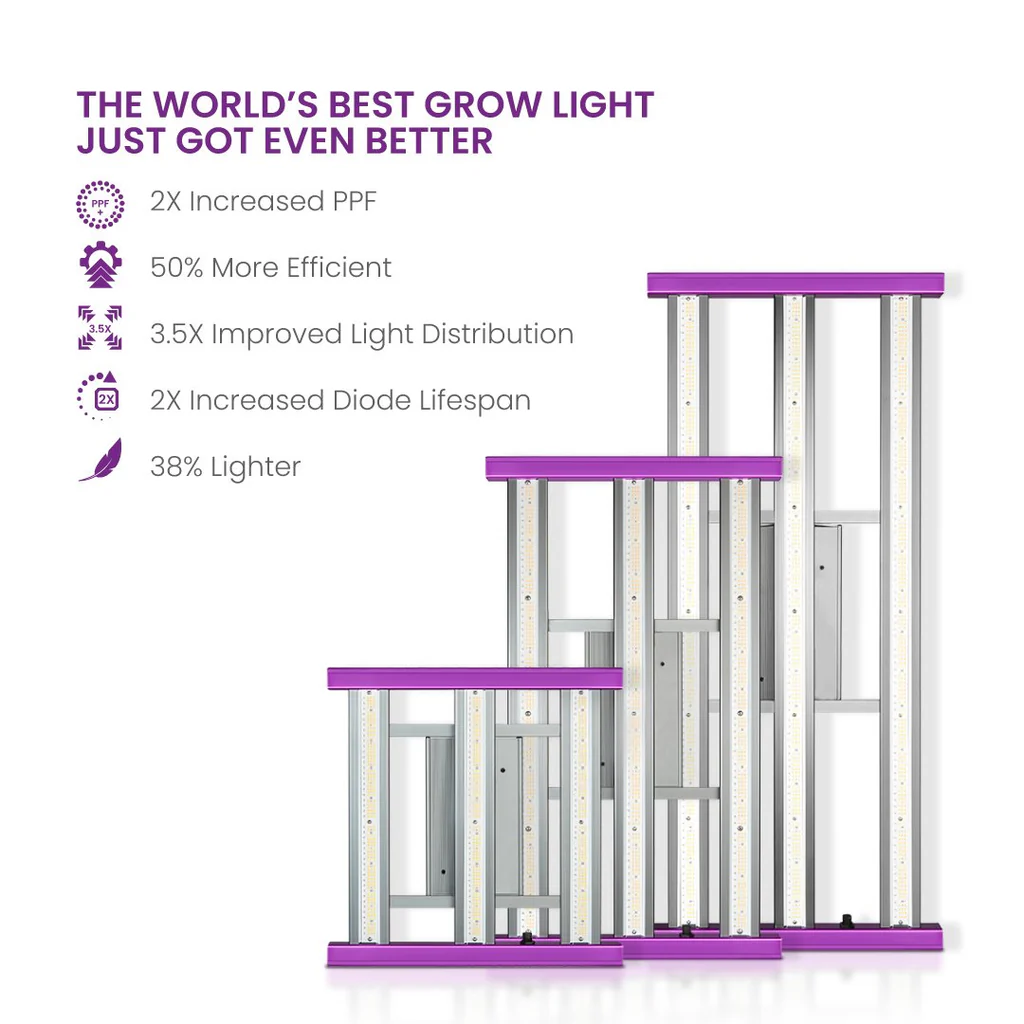
It’s worth noting that some modern lights, like the KIND LED series, focus heavily on maximizing PPF and efficiency while reducing weight and heat. This is the direction the industry is heading: more light, less heat, and smarter power usage.
Real-World Performance Variations
Even two identical-looking LED bars can perform differently. For example, some manufacturers might use a single large driver to power a whole fixture, while others might use multiple smaller drivers. Research has shown that a single 1000W driver can be up to 4% more efficient than five 200W drivers.
That 4% might sound small, but it equates to about 20 $\mu$mol/m²/s of lost light. Over a 3-month grow cycle, that is a massive amount of energy that your plants missed out on, which translates directly to smaller flower sites and lower terpene production.
How Much PPFD Do You Actually Need?
More isn't always better. Plants have a "saturation point" where they can no longer process more light.
- Clones/Seedlings: 100–300 PPFD. Anything more will likely stunt them.
- Vegetative Stage: 400–600 PPFD. This is the sweet spot for rapid leaf and stem growth.
- Flowering Stage: 600–1000+ PPFD. This is where you need the most intensity to drive bud development.
Caution: If you go above 1000 PPFD, you generally need to start supplementing with CO2. Without extra CO2, the plant can't keep up with the light intensity, and you’ll start seeing light bleach or nutrient deficiencies as the plant's metabolism "overheats."

Troubleshooting Your Setup
If your plants are looking "tired," yellowing at the top, or the leaves are "praying" (pointing straight up) too aggressively, you might have too much PPFD. It seems more like a nutrient issue to the untrained eye, but it’s often just the light being too close.
On the flip side, if your plants are "stretching" (long gaps between nodes), they are searching for more light. This is a clear sign that your PPFD is too low. Instead of buying a new light immediately, try lowering your existing fixture or adding reflective film to the walls to concentrate the available photons.
Summary: Stop Chasing Watts
The industry is moving fast, and the marketing can be confusing. You’ll see "1000W Equivalent" LEDs that actually only pull 150W from the wall and produce barely enough light to grow a lettuce leaf.
Don't be fooled by the big numbers on the box. Look for the PPFD maps. Look for the efficacy ratings. At Perfect Gardens, we always recommend checking the PAR (Photosynthetically Active Radiation) charts before making a move.
Your electricity bill is determined by wattage, but your harvest is determined by PPFD. Invest in a light that puts the energy where it belongs: on your plants, not on your power meter. If you're looking to upgrade, check out our LED light collection to find fixtures that actually deliver the intensity they promise.
Happy growing!

Leave a comment
This site is protected by hCaptcha and the hCaptcha Privacy Policy and Terms of Service apply.