
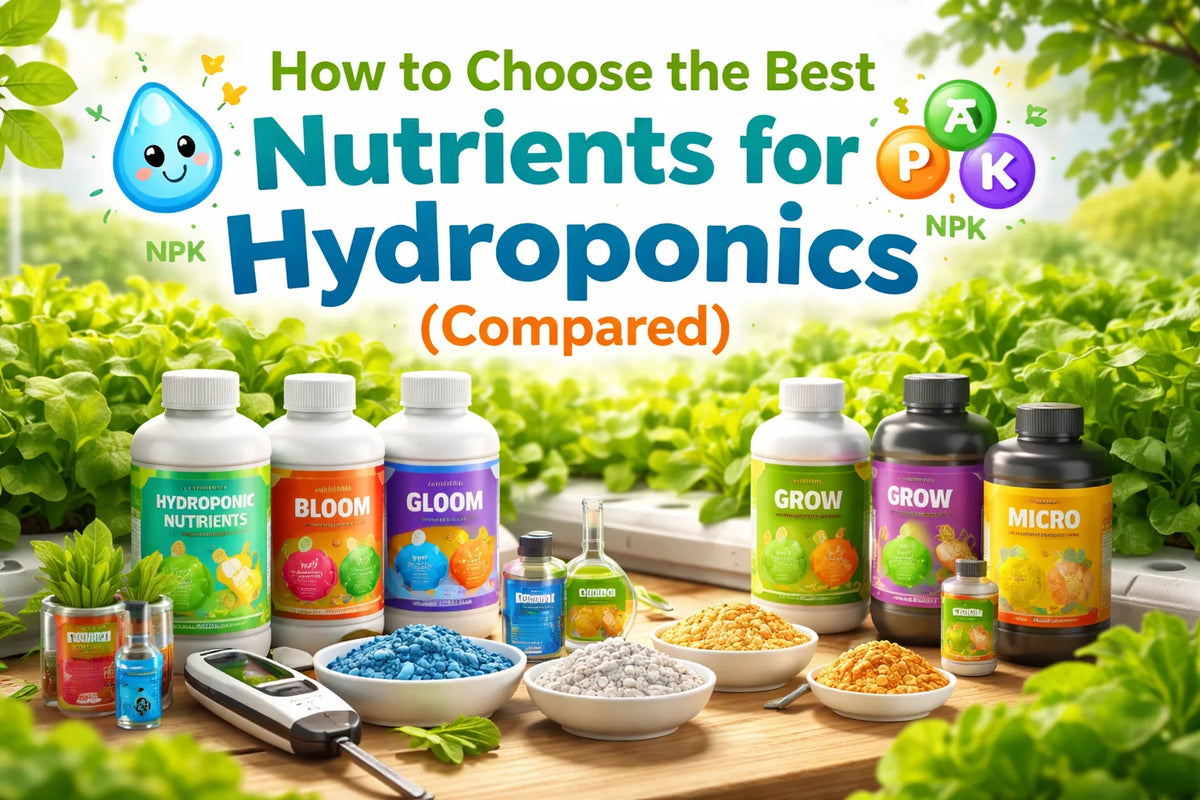
Picking the best nutrients for hydroponics can feel overwhelming. Walk into any grow store or browse online, and you'll find dozens of bottles with different ratios, formulas, and promises. Some are designed for beginners, others for experienced growers chasing maximum yields. So how do you know which one is right for your setup?
The truth is, there's no single "best" nutrient for everyone. Your choice depends on your experience level, what you're growing, and how much time you want to spend managing your system. In this guide, we'll break down the key factors to consider, compare popular options side by side, and help you make an informed decision for your hydroponic systems.
Why Nutrients Matter More in Hydroponics
In soil-based gardening, the growing medium itself provides a buffer. Soil contains organic matter, microbes, and minerals that can compensate for minor nutrient imbalances. Hydroponics doesn't have that safety net.
Your plants are completely dependent on what you put in the water. Get it right, and you'll see faster growth, healthier plants, and bigger harvests. Get it wrong, and problems show up fast: yellowing leaves, stunted growth, nutrient lockout.
That's why choosing the right nutrient formula is one of the most important decisions you'll make for your hydroponic setup.
Key Factors When Choosing Hydroponic Nutrients
Before diving into specific products, let's look at what actually matters when selecting nutrients for your system.
1. Your Experience Level
This is probably the biggest factor. If you're just starting out, you want something simple that won't require constant adjustments or mixing calculations.
Beginners should look for one-part liquid formulas. These come pre-mixed and balanced, so you just measure and pour. Products like Dyna-Gro Foliage Pro fall into this category: straightforward and hard to mess up.
Intermediate and advanced growers often prefer multi-part systems (two-part or three-part). These give you more control over nutrient ratios at different growth stages. You can dial in more nitrogen during vegetative growth and shift to phosphorus-heavy formulas when it's time to flower.
2. What You're Growing
Different plants have different nutritional needs. Leafy greens like lettuce and spinach thrive with higher nitrogen levels to support leaf production. Flowering plants and fruiting crops need more phosphorus and potassium during their bloom phase.
Some nutrient lines are specifically formulated for certain plant types. Others are general-purpose but allow you to adjust ratios based on growth stage.

3. Water Solubility
Here's something that doesn't get talked about enough: not all nutrients dissolve equally well in water. Poor solubility means clumping, clogged lines, and nutrients that sit at the bottom of your reservoir instead of reaching your plants.
The best nutrients for hydroponics dissolve completely and stay in solution. This ensures consistent feeding every time water passes through your system. Look for products specifically designed for hydroponic use: they're formulated for maximum solubility.
4. pH Stability
Nutrient availability is directly tied to pH. Most hydroponic plants prefer a pH range of 5.5 to 6.5. Outside that range, certain nutrients become "locked out" even if they're technically present in your solution.
Some nutrient systems include pH buffering technology that helps maintain stable levels. Advanced Nutrients, for example, includes automatic pH balancing in their formulas. This can save you time on daily maintenance but comes at a higher price point.
5. Cost vs. Performance
Budget matters. Premium nutrients can deliver excellent results, but there are also cost-effective options that perform well for most growers.
Here's a general breakdown:
- Budget-friendly organic options like Bloom Grow and Bloom Flower offer good results without breaking the bank
- Mid-range options like General Hydroponics Flora Series provide a proven track record since the 1970s
- Premium options like House & Garden offer superior concentration and pH stability
Popular Nutrient Systems Compared
Let's put some of the most common options side by side:
| Nutrient System | Type | Best For | Key Advantage |
|---|---|---|---|
| Dyna-Gro Foliage Pro | One-part liquid | Beginners, leafy greens | Simple, no mixing required |
| General Hydroponics Flora Series | 3-part liquid | Intermediate growers, flowering plants | Trusted formula, excellent algae prevention |
| Fox Farm Liquid Trio | 3-part liquid | Flowering plants | Strong reviews, reliable performance |
| Advanced Nutrients pH Perfect | 3-part liquid | Convenience-focused growers | Automatic pH balancing |
| House & Garden | Multi-part | Performance-focused growers | Superior concentration and stability |
In practical growing tests with lettuce, General Hydroponics Flora Series consistently performed well. The slightly pink-colored formula also helps prevent algae growth: a common issue in hydroponic systems that can restrict root nutrient uptake.
The Role of Water Quality
Here's something many growers overlook: your water quality affects how well nutrients work. Tap water contains minerals, chlorine, and other compounds that can interfere with your nutrient solution. Hard water can throw off your calcium and magnesium levels before you even add anything.
This is where water conditioning becomes important. Starting with optimized water means your nutrients dissolve better, stay in solution longer, and become more available to your plants.
How Drops of Balance Makes a Difference
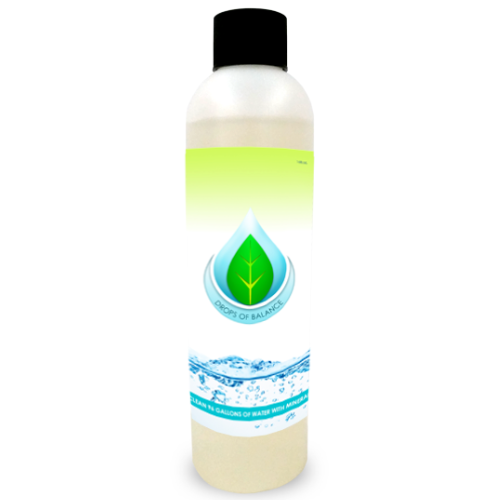
Drops of Balance is designed specifically to address this issue. It mineralizes and purifies your water, creating an optimal base for nutrient absorption. Think of it as preparing the canvas before you paint.
When your water is properly balanced, nutrients become more bioavailable. Your plants can actually use what you're giving them instead of dealing with lockout or deficiency issues caused by poor water quality.
For hydroponic systems, this translates to:
- Better nutrient uptake
- More consistent pH levels
- Healthier root development
- Fewer mysterious deficiency symptoms
It's a small addition to your routine that can make a noticeable difference in results.

Tips for Beginners
If you're new to hydroponics, here's the practical advice:
-
Start simple. Choose a one-part nutrient and master the basics before moving to complex multi-part systems.
-
Invest in a good pH meter. Even with pH-stable nutrients, you need to monitor levels. Cheap meters give unreliable readings.
-
Follow the manufacturer's guidelines. Start at half-strength and work your way up. It's easier to fix underfeeding than to recover from nutrient burn.
-
Change your reservoir regularly. Don't just top off: completely replace your nutrient solution every 1-2 weeks to prevent salt buildup and imbalances.
-
Watch your plants. They'll tell you what they need. Yellowing, spots, curling leaves: these are signals that something needs adjustment.
Tips for Experienced Growers
If you've got a few grows under your belt:
-
Experiment with multi-part systems. The extra control lets you fine-tune for specific growth stages and plant varieties.
-
Consider supplements strategically. Cal-mag, silica, and beneficial microbes can enhance results, but don't add everything at once. Test one variable at a time.
-
Dial in your water first. Products like Drops of Balance can help you establish a consistent baseline that makes nutrient management more predictable.
-
Track everything. Keep a log of your pH, EC/PPM readings, and any adjustments. Patterns emerge over time that help you optimize future grows.
Where to Learn More
Reading about nutrients is one thing: seeing them in action is another. Perfect Gardens TV offers detailed tutorials that walk you through nutrient mixing, pH management, and troubleshooting common issues. Visual demonstrations can clear up confusion faster than any article.
Whether you're setting up your first hydroponic system or optimizing an existing setup, having access to step-by-step video guides makes the learning curve much more manageable.
Making Your Decision
Choosing the best nutrients for hydroponics comes down to matching the product to your situation:
- New to hydroponics? Start with a one-part formula and focus on learning the fundamentals.
- Growing leafy greens? Higher nitrogen formulas with simple application work well.
- Growing flowering or fruiting plants? Multi-part systems give you the flexibility to adjust for different growth stages.
- Want less maintenance? Consider pH-buffering formulas even if they cost more.
- On a budget? Proven options like General Hydroponics offer reliability without premium pricing.
And regardless of which nutrient line you choose, don't neglect your water quality. Starting with optimized, balanced water gives every nutrient formula a better chance of delivering results.


Leave a comment
This site is protected by hCaptcha and the hCaptcha Privacy Policy and Terms of Service apply.