
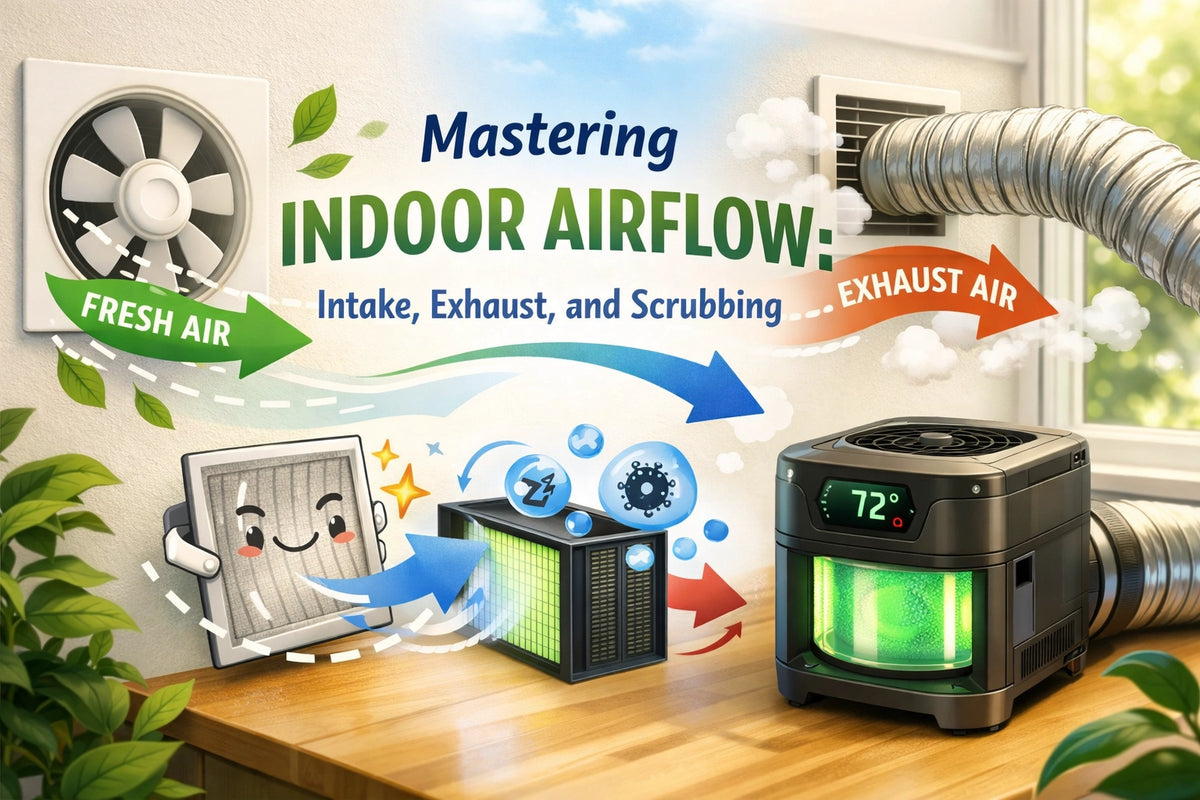
When you walk into a professional grow room, the first thing you notice isn’t just the lights or the smell of the plants: it’s the movement of the air. Airflow is the lifeblood of any indoor garden. It controls temperature, manages humidity, delivers essential CO2 to the leaf surface, and keeps pests like spider mites or fungus gnats from making themselves at home.
The fact of the matter is, you can have the best LED lights and the most expensive nutrients on the market, but if your air is stagnant, your plants will suffer. Mastering indoor airflow requires a three-pronged approach: Intake, Exhaust, and Scrubbing. In this guide, we’re going to break down the technical side of ventilation so you can dial in your environment with confidence.
Why Airflow is Non-Negotiable
Plants "breathe" through tiny pores on their leaves called stomata. During the day, they consume CO2 to fuel photosynthesis. If the air around the leaf becomes still, a "boundary layer" forms where the CO2 is depleted, effectively starving the plant even if the room is full of fresh air.
Furthermore, plants constantly release water vapor through transpiration. Without proper exhaust, this moisture builds up, spiking your humidity and creating a breeding ground for bud rot (Botrytis) and powdery mildew. Proper ventilation ensures that old, humid, CO2-depleted air is swapped for fresh, oxygen-rich, and temperature-stable air.
The Math: Calculating Your Required CFM
The most common mistake growers make is buying a fan based on the size of their ducting rather than the volume of their room. To get this right, you need to calculate CFM (Cubic Feet per Minute).
Step 1: Calculate Room Volume
First, find the total cubic feet of your grow space.
Length x Width x Height = Total Cubic Feet.
For example, if you are using a standard AC Infinity grow tent that is 4’ x 4’ x 7’, your volume is 112 cubic feet.
Step 2: The One-Minute Exchange Rule
In a perfect world, you want to exchange the entire volume of air in your room once every minute. So, for our 112 cubic foot tent, you need a fan that can move at least 112 CFM.
Step 3: Accounting for Resistance (Multipliers)
This is where most growers get tripped up. A fan rated for 112 CFM will not actually move 112 CFM once you attach a carbon filter and ducting. You must apply multipliers to account for "Static Pressure" (resistance).
- Carbon Filter: Add 20-25% to your CFM.
- Ducting: Add 10% for every 90-degree bend and 5% for every 10 feet of horizontal run.
- Heat Load: If you are running high-intensity lights, add another 10-15%.
The Calculation Example:
112 (Base) + 28 (Filter) + 12 (One duct bend) = 152 CFM required.
In this case, a 4-inch fan (usually rated around 200 CFM) would be perfect, as it gives you some "headroom" to run the fan at a lower, quieter speed.

Understanding Static Pressure: The Silent CFM Killer
Static pressure is essentially the resistance your fan has to push or pull against. Think of it like trying to breathe through a straw versus a wide-open mouth. If your fan is rated for 400 CFM but you attach a thick carbon filter and 20 feet of crinkled ducting with three sharp turns, that fan’s actual output might drop to 150 CFM.
Pro-Tip: Keep your ducting as straight and tight as possible. Use rigid ducting if you can, but if you use flexible ducting, pull it taut. Every "sag" or "kink" creates turbulence that slows down your air and makes your fan work harder, which shortens its lifespan.

Exhaust vs. Intake: Creating Negative Pressure
To prevent smells from leaking out of your tent, you want to maintain negative pressure. This means you are exhausting more air out than you are bringing in, causing the walls of the tent to suck in slightly. This ensures that the only way air leaves the room is through your carbon filter.
Exhaust Strategies
Your exhaust fan should always be at the highest point of the room or tent because heat rises. Position your fan and filter near the ceiling to pull out the hottest, most humid air.
Intake Strategies: Passive vs. Active
- Passive Intake: This is the most common method for small-scale growers. You simply open a vent at the bottom of the tent. To maintain negative pressure, your intake hole should be roughly 3 times larger than the diameter of your exhaust duct.
- Active Intake: If your room is getting too hot, you might need a second, smaller fan to "push" fresh air in from a cool source (like an AC vent or a shaded window). Ensure the intake fan is rated lower than the exhaust fan to maintain that crucial negative pressure.
Scrubbing: The Art of Odor Control
Scrubbing refers to using activated carbon to chemically "clean" the air of volatile organic compounds (VOCs): the stuff that makes your plants smell.

Carbon Filter Maintenance
A carbon filter is an investment in your privacy and your neighborly relations. To keep it working efficiently:
- Wash the Pre-filter: The white sleeve on the outside of the filter catches dust and hair. If it gets clogged, your CFM drops significantly. Wash it every 2-3 months.
- Monitor Humidity: This is a big one. Activated charcoal loses its ability to absorb odors when the humidity exceeds 65-70%. If your room is too wet, the carbon pores fill with water molecules instead of odor molecules, and you’ll start smelling your garden from the street.
- Replacement Cycles: Most high-quality filters, like the ones found in our Extraction Kits, last about 12 to 18 months of continuous use. If you start to smell "greenery" outside your exhaust vent, it’s time to swap it out.
Automation and Environmental Control
In the modern grow era, you shouldn't be manually turning fans on and off. Using Controllers allows you to set "triggers." For example, you can program your exhaust fan to ramp up speed only when the temperature exceeds 80°F or the humidity goes above 60%.
This "smart" control prevents you from over-exhausting your room, which can lead to low CO2 levels or drying out your substrate too quickly. High-tech systems even allow you to monitor these stats from your phone.

Common Airflow Mistakes to Avoid
Even with the right math, things can go wrong. Here are a few pitfalls we see often at Perfect Gardens:
- Short-Circuiting the Airflow: If your intake vent is right next to your exhaust fan, the fresh air will get sucked out before it ever reaches the plants. Always place your intake at the bottom and your exhaust at the opposite top corner to ensure a cross-breeze.
- Ignoring Oscillating Fans: Your intake and exhaust handle the exchange of air, but you still need small oscillating fans inside the tent to keep air moving within the canopy. This strengthens stems and prevents "dead spots" of high humidity.
- Using Too Much Ducting: If you can mount your fan directly to your filter, do it. Every inch of ducting between the filter and the fan is a point where odor could potentially leak if there’s a small tear.
Conclusion
Mastering indoor airflow isn't just about buying a big fan; it's about understanding the relationship between volume, resistance, and plant health. By calculating your CFM accurately, managing static pressure, and maintaining your scrubbing equipment, you create a stable environment that allows your plants to reach their full genetic potential.
If you’re ready to upgrade your ventilation setup or need help sizing a system for a custom room, check out our full range of Grow Essentials. Whether you are just starting with Propagation or you're preparing for a massive Harvest, the right air is just as important as the right light. Keep that air moving, and your garden will thank you.



Leave a comment
This site is protected by hCaptcha and the hCaptcha Privacy Policy and Terms of Service apply.