
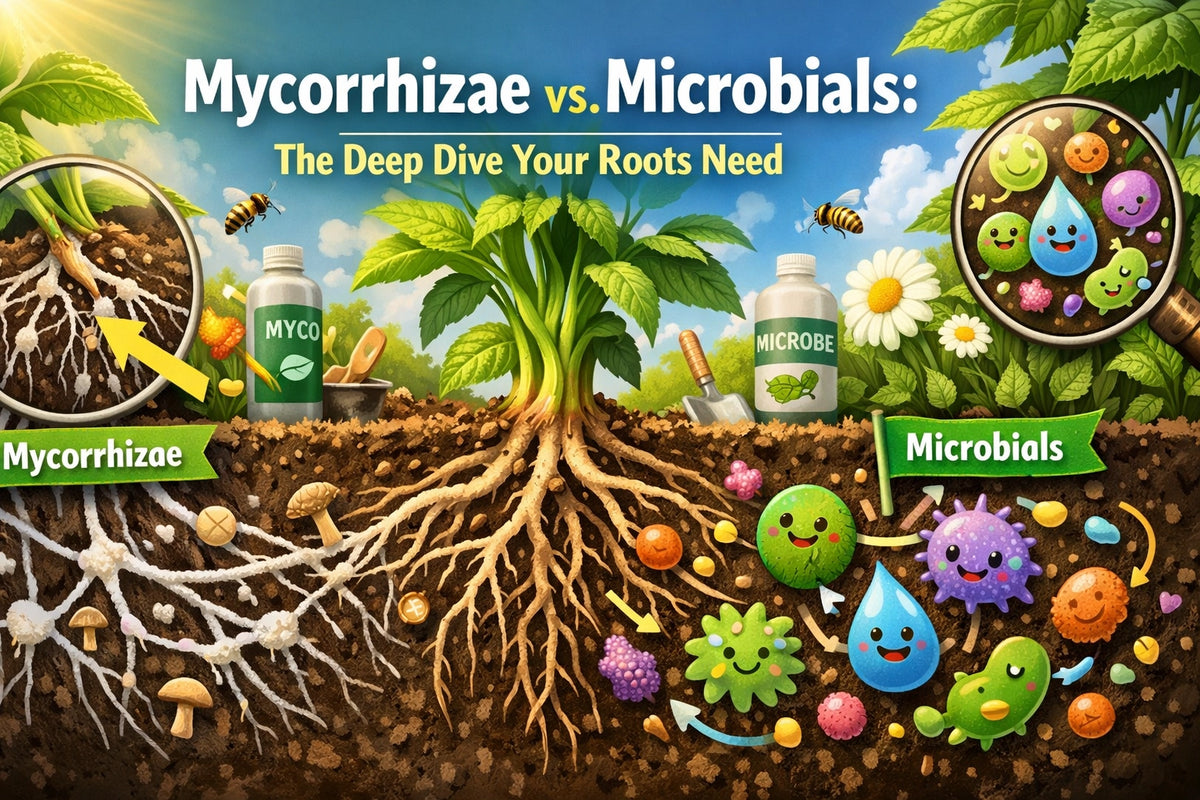
Walk into any grow shop and ask about beneficial biology, and you'll likely get handed two products: a mycorrhizae inoculant and a microbial blend. Both promise healthier roots, better nutrient uptake, and bigger yields. But here's where most growers get stuck, they're not the same thing, and they don't do the same job.
Understanding the difference between mycorrhizae for plants and microbial inoculants isn't just gardening trivia. It's the key to building a root zone that actually works the way nature intended. Let's break down what each one does, how they're different, and when you should be using them.
What Mycorrhizae Actually Does
Mycorrhizae are fungi. Not the kind that cause disease, these are symbiotic fungi that form partnerships with plant roots. The relationship is simple: the plant feeds the fungi sugars from photosynthesis, and in return, the fungi extend the root system far beyond what the plant could manage alone.
Here's where it gets interesting. Mycorrhizal hyphae (those thread-like fungal branches) can extend up to 176 miles per ounce of soil. That's not a typo. These microscopic highways access water and nutrients that regular roots simply can't reach. In many cases, mycorrhizae are responsible for up to 50% of a plant's total nutrient uptake, especially micronutrients like zinc, phosphorus, and manganese.

There are two main types you'll encounter:
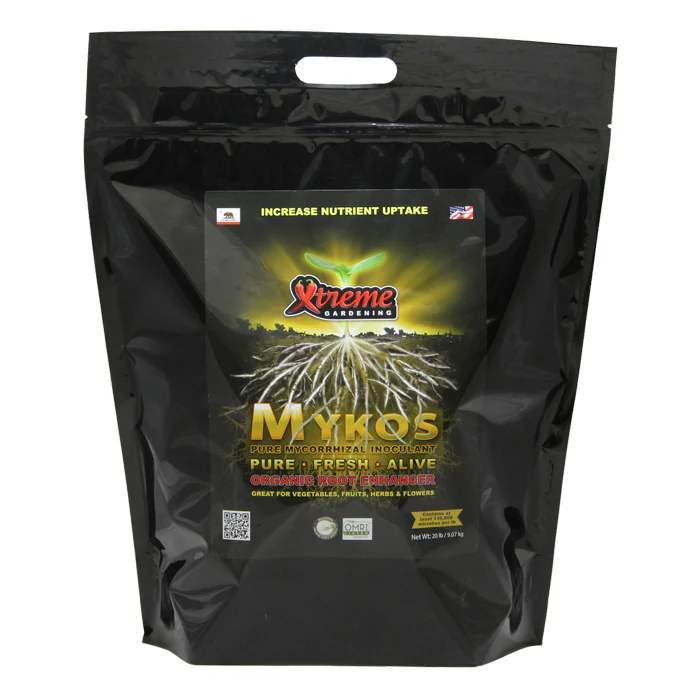
Arbuscular Mycorrhizae (AM) penetrate the plant cell walls and interact directly with cell membranes. Most vegetables, herbs, and flowering plants form AM relationships. These are the fungi you'll find in products like Xtreme Gardening Mykos.
Ectomycorrhizae (EcM) wrap around roots with a fungal sheath but don't penetrate cell walls. These primarily associate with trees and woody plants, not your typical indoor garden candidates.
For most growers, AM fungi are what matter. They're the workhorses of the root zone, essentially acting as a secondary root system that's far more efficient at scavenging nutrients than the plant could ever be on its own.
What Microbial Inoculants Bring to the Table
Now let's talk about microbial inoculant products. These are blends of beneficial bacteria and sometimes other microorganisms: but they're fundamentally different from mycorrhizae in both structure and function.
Bacteria are free-living organisms. They don't form the same kind of intimate partnership with roots that mycorrhizae do. Instead, they live in the soil and the rhizosphere (the area immediately around roots), where they perform a different set of critical jobs.
Primary Functions of Beneficial Microbes:
-
Nutrient Cycling - Bacteria break down organic matter and mineralize nutrients, converting them into plant-available forms. They're the decomposers.
-
Pathogen Suppression - Beneficial bacteria compete with harmful organisms for space and resources, effectively crowding out potential problems before they start.
-
Hormone Production - Many beneficial bacteria produce plant growth hormones and signaling compounds that influence root development and stress response.
-
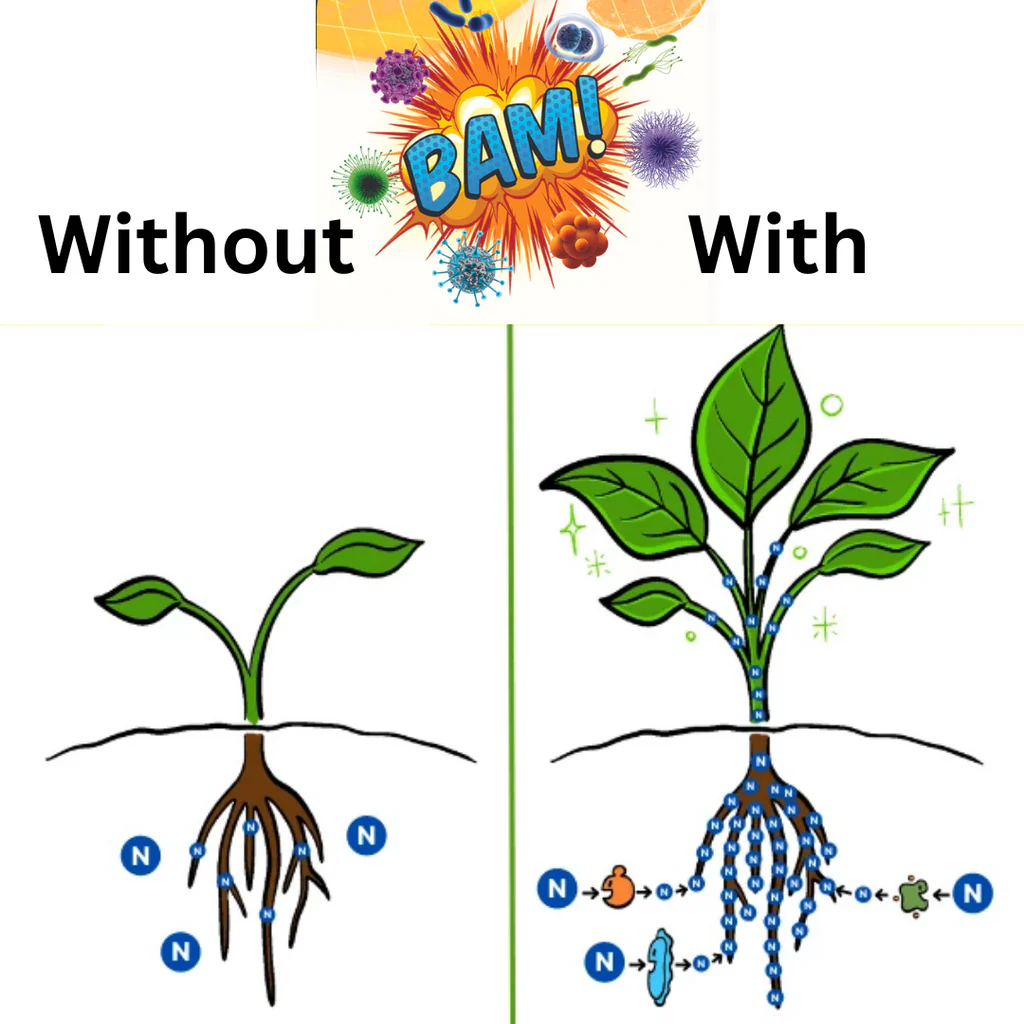
Nitrogen Fixation - Specific bacteria like Azospirillum can pull nitrogen from the air and make it available to plants (products like Xtreme Gardening Azos specialize in this).
The key difference? Bacteria convert about 15-20% of consumed carbon into stable organic matter. Mycorrhizae convert 40-55%. That efficiency gap matters: mycorrhizae are far better at building long-term soil structure and stability.

The Real Difference: Extension vs. Breakdown
Here's the simplest way to understand the distinction:
Mycorrhizae extend your root system. They physically reach nutrients and water that would otherwise be inaccessible. Think of them as adding square footage to your nutrient-gathering operation.
Microbes break down and process nutrients. They transform locked-up nutrients into forms your plants can actually use. They're the kitchen staff, preparing the meal.
Neither one is "better." They serve complementary roles. A plant with mycorrhizae but no beneficial bacteria might have access to nutrients it can't utilize. A plant with bacteria but no mycorrhizae might have nutrients available but lack the physical capacity to gather them efficiently.
This is why the research consistently shows that co-inoculations: using both mycorrhizae and bacterial inoculants together: produce significantly better results than using either one alone.
How They Work Together (And Why You Want Both)
The relationship between mycorrhizal fungi and soil bacteria is surprisingly complex. They're not just coexisting: they're actively influencing each other's success.
Mycorrhizal fungi create habitats. Their hyphal networks provide surfaces and micro-environments where beneficial bacteria thrive. In ecosystems dominated by ectomycorrhizal plants, you find more specialized bacterial communities because the fungi create more diverse physical niches.
Bacteria, in turn, support mycorrhizal colonization: especially with ectomycorrhizal types. They can help suppress organisms that would otherwise compete with or harm the fungi.
Together, they create what researchers call "microbial community dynamics": a living system that's more resilient, more efficient, and more productive than the sum of its parts.

The data backs this up. Studies show that total plant biomass increases significantly when both mycorrhizae and bacteria are present compared to single inoculations. The effects are most pronounced with arbuscular mycorrhizae, which makes sense for most garden and hydroponic applications.
When to Use Mycorrhizae
Apply mycorrhizae at transplant or during propagation. The fungi need direct contact with roots to colonize effectively. Once established, the relationship is relatively permanent for that plant's life cycle.
Best scenarios for mycorrhizae for plants:
- New transplants or seedlings
- Plants in sterile growing media (coco, rockwool, hydroton)
- High-phosphorus demand situations
- Plants showing micronutrient deficiencies despite adequate feeding
- Any time you're trying to establish a long-term root system
One caution: Don't oversaturate your soil or media with phosphorus if you want mycorrhizae to establish. High phosphorus levels can inhibit colonization because the plant doesn't "need" the fungi when phosphorus is already abundant.
When to Use Microbial Inoculants
Microbial inoculants work best as ongoing treatments. Unlike mycorrhizae, bacterial populations can fluctuate based on conditions. Regular applications help maintain beneficial populations.
Best scenarios for microbial inoculant use:
- Throughout the growing cycle, especially during vegetative growth
- After any stress event (heat, drought, pest pressure)
- In systems prone to root disease or pathogen pressure
- When transitioning between growth stages
- As part of compost tea or foliar spray programs
Some growers apply microbial inoculants weekly. Others do bi-weekly applications. The frequency depends on your system: hydroponic setups often need more frequent applications than living soil systems that maintain populations naturally.
Practical Application: Using Both Strategically
Here's a straightforward protocol that makes sense for most growers:
At Transplant:
- Apply mycorrhizae directly to root zone or planting hole
- Use a microbial inoculant to establish initial bacterial populations
Vegetative Growth:
- Weekly or bi-weekly microbial inoculant applications
- No need for additional mycorrhizae unless transplanting again
Flowering/Fruiting:
- Continue microbial applications, possibly reducing frequency
- Consider adding molasses or other carbon sources to feed beneficial biology
After Stress Events:
- Immediate microbial inoculant application
- Monitor root health and consider mycorrhizae if transplanting to recovery
The key is understanding that mycorrhizae are about establishing infrastructure, while microbes are about maintaining activity. You build the highways once; you keep traffic moving continuously.
The Bottom Line
The confusion between mycorrhizae and microbial inoculants is understandable: they're both "beneficial biology," both improve plant health, and both get lumped together in marketing. But treating them as interchangeable means you're likely leaving performance on the table.
Mycorrhizae extend your root system and improve nutrient access. Microbial inoculants process nutrients and protect against pathogens. Used together, they create a root zone ecosystem that outperforms either approach alone.
For most growers, that means applying quality mycorrhizae at transplant and maintaining beneficial bacterial populations throughout the grow cycle. It's not complicated, but it does require understanding what each product actually does: and now you've got that figured out.
The root zone isn't just where plants anchor themselves. It's where the real action happens. Give it the right biology, and everything else gets easier.


Leave a comment
This site is protected by hCaptcha and the hCaptcha Privacy Policy and Terms of Service apply.