
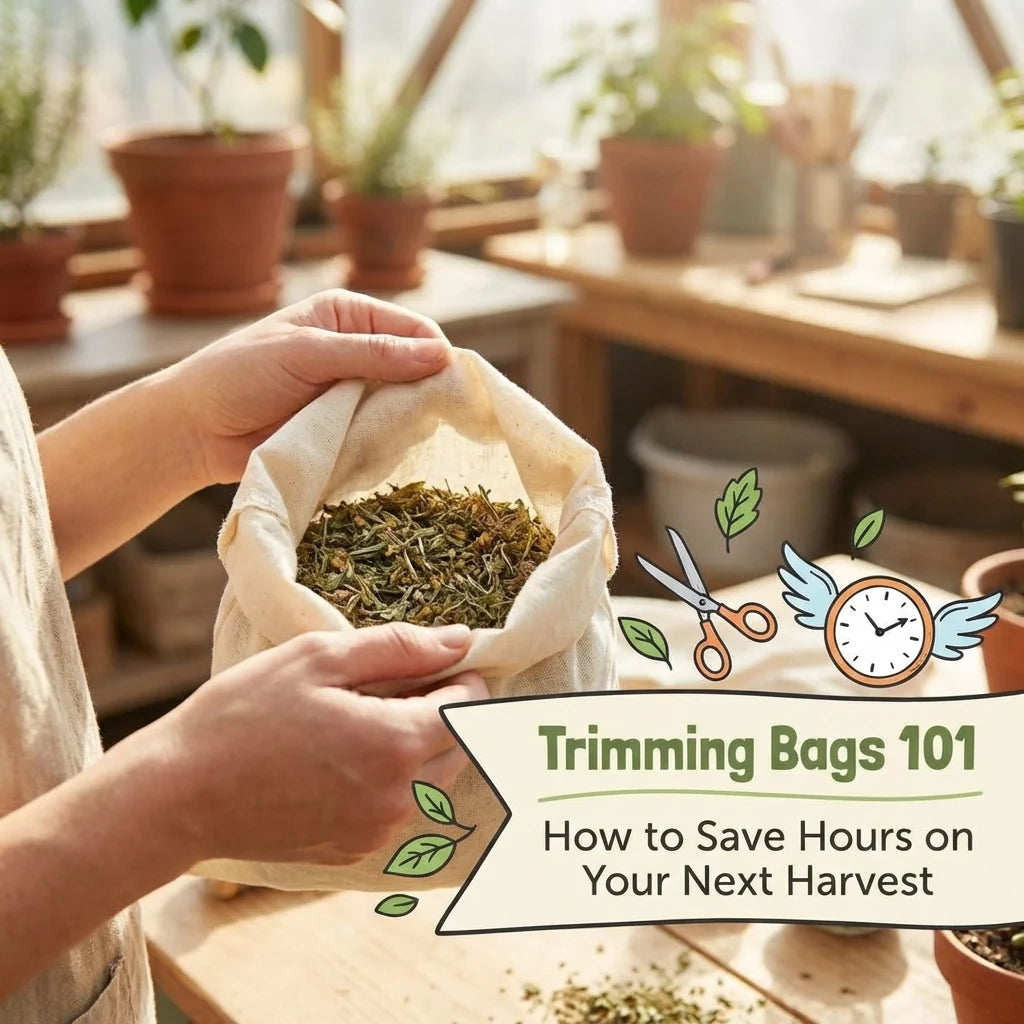
If you’ve been gardening for more than a season, you know the feeling. The excitement of a successful grow is slowly replaced by the looming shadow of "Trim Jail." You’ve spent months hovering over your plants, dialing in your LED grow lights, and perfecting your nutrient schedule. Now, you’re staring at a mountain of high-quality flower that needs to be manicured, and you realize you’re about to spend the next three days hunched over a tray with a pair of sticky scissors.
The fact of the matter is, hand-trimming is the biggest bottleneck in the entire cultivation process. It’s tedious, it’s hard on your back, and if you’re doing it alone, it can take the joy right out of the harvest. This is exactly why trimming bags have become a game-changer for home growers and small-scale professional operations alike.
In this guide, we’re going to break down everything you need to know about trimming bags: what they are, how they work, and how to use them to reclaim your weekend without sacrificing the quality of your hard-earned harvest.
What Exactly is a Trimming Bag?
A trimming bag is a specialized, blade-free tool designed to remove excess leaf material from your dried flower using friction and gentle tumbling. Unlike motorized trimming machines that use spinning metal blades (which can often be aggressive and damage the delicate trichomes), a trimming bag relies on the texture of the bag itself and the movement of the material.
Most trimming bags, like the popular options found in our grow essentials collection, are made from high-durability fabric with internal mesh screens. These screens act as a gentle abrasive surface. As you rotate or shake the bag, the "crow's feet" and sugar leaves: which are more brittle than the flower itself: break off and fall through the mesh, leaving you with clean, manicured buds.

Why Use Trimming Bags Over Scissors?
It seems more like a shortcut that might hurt quality, right? This is actually not the case. When used correctly, a trimming bag can produce results that are nearly indistinguishable from a hand-trimmed product, but in a fraction of the time.
Here are the primary advantages:
- Massive Time Savings: This is the big one. A process that takes four hours by hand can often be completed in about five to ten minutes with a trimming bag.
- Reduced Handling: Every time you touch a bud with your fingers or scissors, you’re knocking off resin glands (trichomes). Because trimming bags use a "tumble" action, there is less direct physical contact with the flower than there is with manual snipping.
- Space Efficiency: You don't need a giant table setup for three people to sit around. You just need enough space to move the bag.
- Uniformity: The bag treats every bud equally. You won't get "lazy" halfway through the bag like you might during hour six of hand-trimming.
The Science of Success: It’s All About Moisture Content
If there is one "secret" to using trimming bags effectively, it’s timing. You cannot use these on wet plants. If you try to tumble freshly cut, "wet" material, you’re going to end up with a sticky, smashed mess that looks like a lawnmower ran over it.
Trimming bags are strictly for dry trimming.
To get that professional look, your material needs to be at the "Goldilocks" stage of dryness: not too wet, not too dry. The goal is to have the leaves brittle enough to break off, while the buds remain resilient enough to hold their shape.
The "Stem Snap" Test:
- Too Wet: The stems bend completely without making a sound. If you try to trim now, the leaves will just mush against the flower.
- Just Right: The smaller stems "snap" when bent, but the larger main stems still have a bit of a bend to them before they break. This usually indicates a moisture content of around 15-20%.
- Too Dry: Everything is "crunchy." If you tumble now, your buds will turn into dust, and you’ll lose all your valuable Kief to the bottom of the bag.

Caption: A close-up of properly dried flower ready for the trimming bag: the leaves should look slightly curled and brittle.
Step-by-Step: How to Use a Trimming Bag
Using the bag is straightforward, but it requires a bit of "feel." Follow these steps to ensure you don't over-process your harvest.
Step 1: Preparation
Buck your plants. This means removing the buds from the large main stems. You want to put "popcorn" and "A-grade" buds into the bag, but you don't want long, thick branches in there. Those branches can act like spears and beat up your flower during the tumble.
Step 2: Loading the Bag
Don't overstuff it! Most bags work best when they are about 1/2 to 2/3 full. The material needs room to move and tumble. If it's too packed, the friction won't happen, and the leaves won't break off.
Step 3: The Tumble
Hold the bag by the handles. You aren't trying to win a marathon here: be gentle. Rotate the bag in a circular motion, or flip it end-over-end.
- Pro Tip: Start with 2 minutes of tumbling.
- Stop, open the bag, and check the progress.
- Most batches only need 3 to 5 minutes total to reach a 90% clean finish.
Step 4: The Sift
Most high-quality trimming bags have a built-in sifting screen. Once the leaves have broken off, you can shake the bag so the "trim" falls into a separate compartment. This leaves your clean flower in the main chamber and your shake/trim at the bottom, ready to be used for extracts or edibles.
Common Pitfalls and How to Avoid Them
Even with the best tools, things can go wrong if you aren't paying attention. Here are a few things to watch out for:
- Static Buildup: In very dry environments, static can cause trichomes to stick to the sides of the bag. If this happens, you might want to lightly wipe the outside of the bag with a dryer sheet (don't touch the inside!) or use a humidifier in your processing room.
- Over-Tumbling: It’s tempting to keep going until every single microscopic leaf is gone. Don't do it. It’s better to have a 95% clean bud than a 100% clean bud that has lost half its weight because you tumbled it for 20 minutes. You can always do a quick "touch-up" with scissors on the few remaining leaves.
- Temperature Matters: It is much easier to trim when the material is cool. If it’s 80 degrees in your garage, the resin will be soft and "smeary." If you can, process in a cool room (60-65°F).
Post-Trim: Storage and Curing
Once your trimming bag has done its job, your work isn't quite over. You need to stabilize that moisture. Since the bag works best when the flower is slightly on the drier side of the spectrum, you’ll want to move your manicured buds into airtight containers immediately.
We highly recommend using two-way humidity control packs, like Boveda 62%, to ensure the flower cures perfectly. These packs will add moisture back if the flower is too dry or pull it out if it’s too wet, keeping your harvest at that perfect "sticky-but-burnable" consistency.

Is a Trimming Bag Right for You?
The fact of the matter is, if you are growing one small plant in a closet setup, a pair of scissors is probably all you need. But as soon as you scale up to a 4x4 or 5x5 grow tent full of plants, the math changes.
If you value your time: and if you’d rather spend your weekend starting your next round of clones using DAPLUG sponge cubes instead of snipping leaves: then a trimming bag is one of the best investments you can make.
It’s about working smarter, not harder. By automating the most labor-intensive part of the harvest, you keep the hobby fun and the results professional.
Need to gear up for your next harvest? Check out our full range of harvesting and pruning tools to find the perfect fit for your garden. Happy harvesting!



Leave a comment
This site is protected by hCaptcha and the hCaptcha Privacy Policy and Terms of Service apply.