
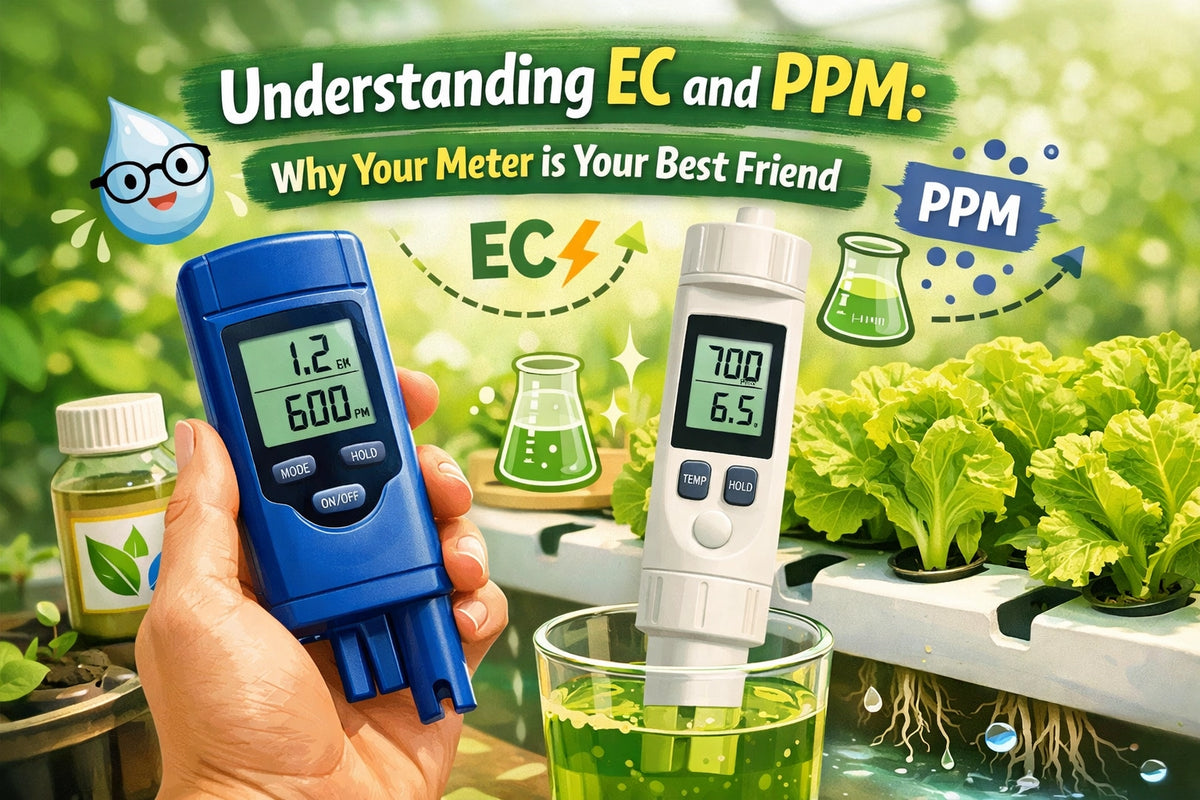
Hey there, fellow growers! Mark here. If you’ve been hanging around the Perfect Gardens community for a while, you know we’re all about making sure your plants have the best life possible. But let’s be real: sometimes gardening: especially hydroponics: can feel like you’re trying to learn a second language. You start hearing terms like EC, PPM, TDS, and pH, and suddenly it feels more like a high school chemistry final than a relaxing hobby.
Today, I want to pull back the curtain on two of the most important numbers you’ll ever track in your grow room: EC and PPM. If you’ve ever wondered why your plant’s leaves are turning "crispy" at the tips or why they seem to be growing at a snail’s pace despite you dumping in expensive nutrients, this is the guide for you. Your meter isn't just a gadget; it's your plant's voice. Let's learn how to listen to it.
The Basics: What Are We Actually Measuring?
When we talk about EC and PPM, we are talking about the "strength" of your nutrient solution. In a soil-based garden, the soil acts as a buffer and a pantry for food. In hydroponics, you are the chef, the waiter, and the pantry. You control exactly what goes into the water.
What is EC?
EC stands for Electrical Conductivity. Here is the science in plain English: Pure water is actually a pretty poor conductor of electricity. However, when you add mineral salts (the stuff in your nutrients), those salts dissolve into "ions." These ions carry an electrical charge.
The more nutrients you add to the water, the more ions there are, and the better the water conducts electricity. An EC meter simply sends a tiny electrical current between two probes and measures how easily it flows. The higher the number, the more "food" is in the water.
What is PPM?
PPM stands for Parts Per Million. This is a measurement of the total mass of the dissolved solids in your water. If you have a reading of 500 PPM, it literally means that for every million parts of liquid, 500 of them are nutrient particles.
The funny thing is, your meter doesn't actually count particles. Every PPM meter on the market is actually an EC meter in disguise. It measures the electrical conductivity and then uses a math formula to "guess" the PPM.
The Great Conversion Confusion: Why EC is King
This is where many beginners get tripped up. Because PPM is a calculated number, different manufacturers use different "scales" to do the math. The two most common are the 500 Scale (often used in the USA and called TDS) and the 700 Scale (often used in Australia and the UK).
Imagine if you asked two people how far it was to the grocery store. One says "1 mile" and the other says "1.6 kilometers." They are both right, but if you don't know which unit they’re using, you’re going to be confused.
- EC 1.0 on a 500 scale = 500 PPM
- EC 1.0 on a 700 scale = 700 PPM
If your nutrient bottle says to feed at 1000 PPM, but your meter is on a different scale than the manufacturer’s chart, you could be overfeeding or underfeeding your plants by 40%! This is why I always tell people: Learn to read EC. An EC of 1.2 is always an EC of 1.2, no matter where you are in the world or what brand of meter you use. It’s the universal language of plant feeding.
Why Your Meter is Your Best Friend
You might be thinking, "Mark, I follow the instructions on the bottle. Why do I need a meter?"
The fact of the matter is that nutrient companies want to sell nutrients. Their "suggested" dosage is often the absolute maximum a plant can handle under perfect conditions (perfect light, perfect CO2, perfect temps). In the real world, your plants might only need half of that.
Without a meter, you are flying blind. Here is what your meter actually does for you:
- Prevents Nutrient Burn: If your EC is too high, the plant can't take up water properly because the salt concentration outside the roots is higher than inside. This leads to "burned" tips.
- Prevents Deficiencies: If your EC is too low, your plant is starving. You’ll see slow growth and pale leaves.
- Monitors Plant Appetite: This is the pro secret. By checking the EC of your reservoir every day, you can tell if your plant is drinking more water than it is eating nutrients (which makes the EC go up) or eating more nutrients than it is drinking water (which makes the EC go down).

How to Read Your Meter and Adjust the Strength
Using the meter is the easy part. Knowing what to do with the information is where the magic happens.
Step 1: Check Your Starting Water
Before you add any nutrients, test your tap water. Most tap water has an EC between 0.1 and 0.5. If your water starts at 0.6 EC, you have a lot of "junk" (like chlorine or heavy minerals) in there already. You might want to look into water purification or products like Drops of Balance to help clean things up before you even start.
Step 2: Mix Your Nutrients
Add your nutrients to the water, stir it well, and let it sit for a few minutes. Then, dip your meter in.
Step 3: Compare to Your Plant's Stage
Plants have different appetites depending on how old they are.
- Seedlings/Clones: EC 0.4 – 0.8
- Early Veg: EC 1.0 – 1.2
- Late Veg/Early Bloom: EC 1.3 – 1.6
- Full Bloom: EC 1.7 – 2.2 (Be careful here!)
Step 4: The Adjustment
- If the EC is too high: Add more plain, pH-balanced water to the reservoir to dilute the solution.
- If the EC is too low: Add a little more concentrated nutrient solution.

Troubleshooting the "Rising EC" Mystery
One of the most common questions I get at Perfect Gardens is: "Mark, I haven't added any nutrients, but my EC keeps going up every day. What's happening?"
This is a classic sign that your plants are thirsty, but not hungry. They are drinking the water and leaving the mineral salts behind. As the water level drops, the concentration of salts increases. This usually happens if your grow room is too hot or the humidity is too low, causing the plants to transpire (sweat) excessively.
If you see the EC rising, top off your reservoir with plain water. It’s a sign you should probably lower your overall nutrient strength next time you do a full reservoir change.
The Limitations: What the Meter Won't Tell You
I love meters, but they aren't magic wands. It is important to remember that an EC/PPM meter tells you how much is in the water, but it doesn't tell you what is in the water.
Your meter might show a perfect EC of 1.5, but if your plant has already "eaten" all the Nitrogen and left all the Potassium behind, your plant will still show a deficiency. This is why we recommend doing a full reservoir change every 7 to 10 days. It resets the balance and ensures your plants aren't sitting in a "salty soup" of leftover minerals they don't want.
Also, your meter doesn't account for organic matter. If you are using thick, organic teas or compost extracts, the particles might be too large to conduct electricity, giving you a false low reading. If you’re going organic, you’ll need to rely more on your eyes and less on the digital display.
Maintenance: Keeping Your Friend Happy
A dirty meter is worse than no meter at all because it lies to you. Mineral salts will build up on the probes over time, leading to inaccurate readings.
- Rinse After Use: Always rinse the probe with distilled or RO water after testing.
- Calibrate Regularly: At least once a month, use a calibration solution to make sure the "brain" of the meter is still accurate.
- Storage: Store the probe according to the manufacturer's instructions. Some need to stay wet, others need to be dry.
If you’re looking for a reliable setup, check out our controllers and meters section to find gear that won't let you down mid-harvest.
Final Thoughts
At the end of the day, gardening is about the relationship between you and your plants. Using an EC or PPM meter isn't about being a "tech geek": it's about giving your plants exactly what they need, when they need it. It removes the guesswork and helps you avoid the common pitfalls that kill so many harvests.
Whether you are just starting out with one of our complete hydroponic systems or you're a seasoned pro fine-tuning your LED light setup, keep that meter handy. It really is your best friend in the grow room.
If you have questions about which meter is right for you or you’re struggling to dial in your nutrient strength, don't hesitate to reach out. We’re here to help you grow your best garden yet!
Happy growing!
: Mark, CEO of Perfect Gardens


Leave a comment
This site is protected by hCaptcha and the hCaptcha Privacy Policy and Terms of Service apply.