
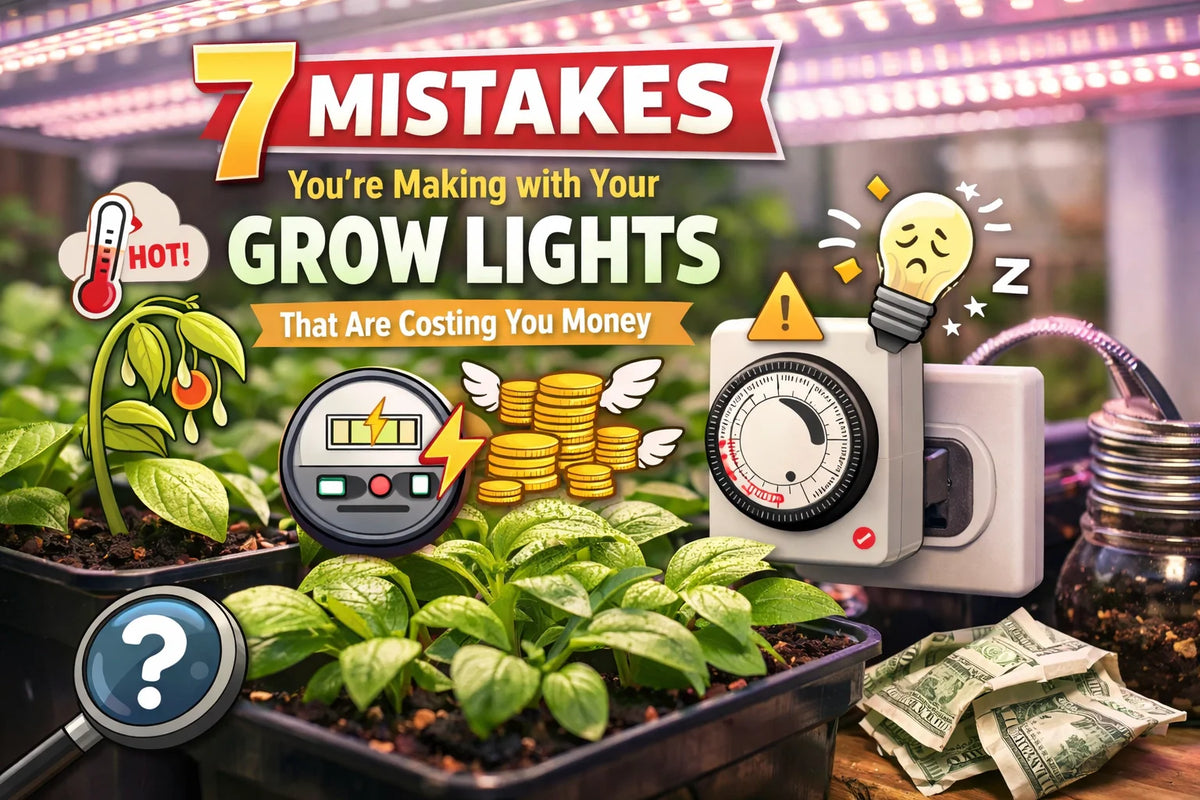
Let’s be real: setting up an indoor garden isn't exactly a "budget" hobby. Between the nutrients, the medium, the seeds, and the environment, the costs add up quickly. But the single biggest investment: and the one that usually hits your electric bill the hardest: is your lighting system.
At Perfect Gardens, we see growers spend thousands on top-tier genetics and high-end nutrients, only to bottleneck their entire harvest because of a few simple mistakes with their grow lights. Lighting isn't just about "turning on a lamp"; it’s about simulating the sun in a controlled environment. If you get it wrong, you aren't just losing out on yield: you are literally throwing money away.
The fact of the matter is that most growers are making at least one of these seven mistakes. Let’s break them down so you can stop wasting cash and start seeing the ROI your garden deserves.
1. Selecting the Wrong Light Spectrum
Plants don’t see light the same way humans do. While we might think a bright white light looks "natural," plants have very specific biological needs at different stages of their life cycle. One of the most common ways growers lose money is by using a light with a spectrum that doesn't match their plant's growth phase.
In the vegetative stage, plants crave blue light. This keeps them compact, encourages thick stems, and promotes leafy growth. If you provide too much red or far-red light during "veg," your plants will stretch. This results in "lanky" plants that can’t support their own weight once they start flowering. On the flip side, if you lack robust red light during the flowering phase, your buds won't pack on the weight or density you're looking for.
Investing in a full-cycle LED, like those found in our grow lights collection, allows you to carry a plant from seed to harvest without changing fixtures. Many modern lights even feature "tunable" spectrums, so you can dial in exactly what the plant needs when it needs it.
2. Buying Low-Quality "Bargain" LED Fixtures
We get it: those cheap LED panels on discount sites look tempting. They claim "2000 Watts" for a fraction of the price of a professional fixture. But here is the catch: those ratings are almost always a lie.
Low-quality lights cut corners on three main things: diode efficiency, spectrum accuracy, and safety. Cheap diodes lose their intensity much faster than high-quality ones, meaning your "new" light might be 20% less effective by your second harvest. Furthermore, budget fixtures often lack proper heat sinking. Excess heat doesn't just hurt the plant; it kills the electronics.
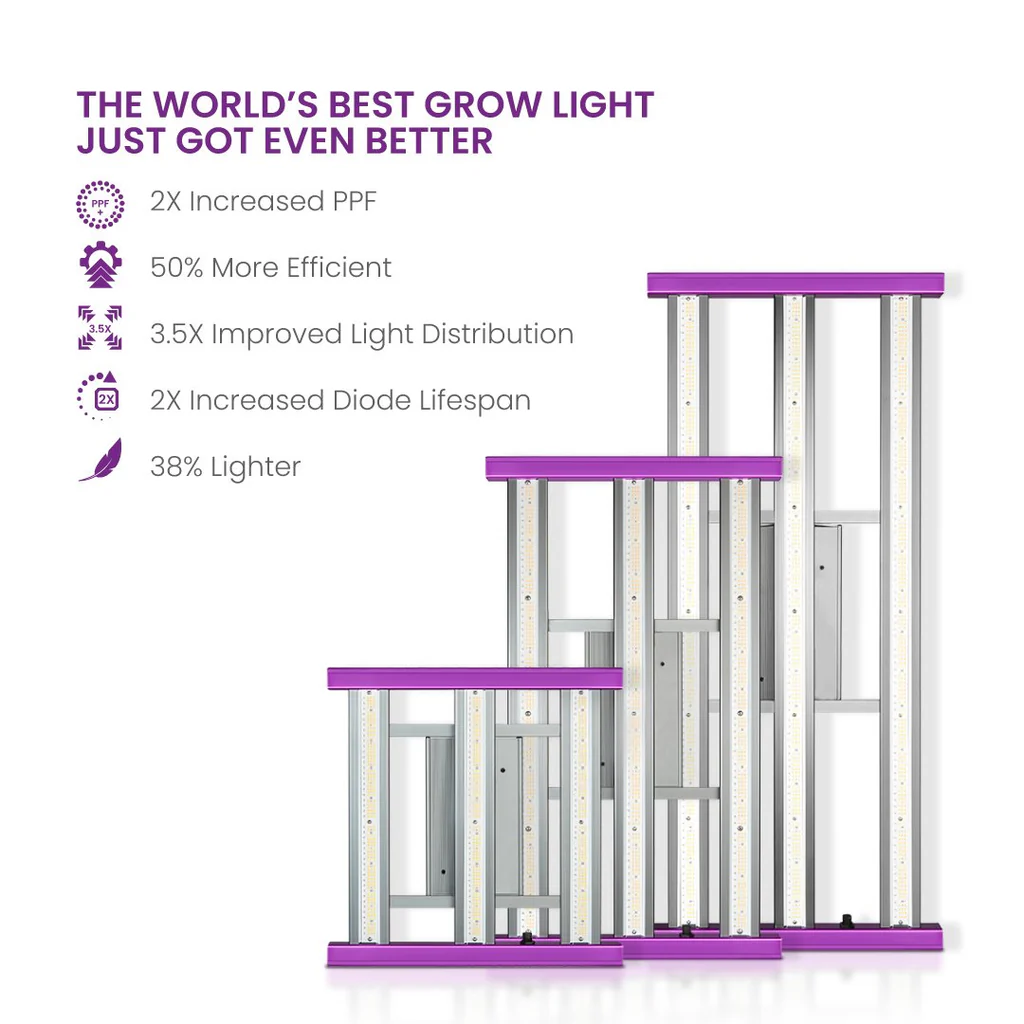
Buying a cheap light often means buying it twice. If a light fails in the middle of a flowering cycle and you lose a crop while waiting for a replacement, that "bargain" just cost you thousands in lost product. Quality fixtures, such as the KIND LED X420, offer 2X increased PPF and 50% higher efficiency, which pays for itself in just a few harvests.
3. Mounting Lights at the Wrong Height
This is perhaps the most common "invisible" money-waster. If your light is too high, you are losing intensity. Due to the Inverse Square Law, doubling the distance between the light and the plant doesn't just halve the light: it reduces it to a quarter of its original intensity. This leads to "stretching," where the plant spends all its energy trying to reach the light rather than building roots or flowers.
Conversely, hanging a light too low can lead to light stress or "bleaching." This is where the light is so intense that it destroys the chlorophyll in the leaves, turning them white and stopping photosynthesis.
It seems more like common sense to just "eyeball it," but this is not the case. Every light has a manufacturer-recommended hanging height. If you don't follow it, you are either starving your plants or burning them: both of which cost you money in the form of reduced yields.
4. Focusing on Wattage Instead of PPFD and PAR
If you are still buying lights based on "Watts," you are living in the 1990s. Wattage measures how much electricity a light pulls from the wall; it does not measure how much light your plants are actually receiving.
The metrics that actually matter are PAR (Photosynthetically Active Radiation) and PPFD (Photosynthetic Photon Flux Density). PAR is the range of light plants can use, and PPFD is the amount of that light hitting a specific spot on your canopy.
A high-wattage, inefficient light will produce a lot of heat and a high electric bill, but very little usable light for the plant. A high-efficiency LED might use half the wattage but provide double the PPFD. When shopping, always look for PAR maps that show light distribution. You want even coverage across the entire tent, not just a "hot spot" in the middle.

5. Improper Photoperiod and Timing
Your plants need a "sleep" schedule. Neglecting the photoperiod: the amount of light vs. dark a plant receives: is a fast track to disaster. For most photoperiod-sensitive plants, even a tiny "light leak" during their dark cycle can cause them to re-vegetate or turn "hermaphrodite," producing seeds instead of flowers.
Wasting electricity is another factor here. If your plants have reached their "saturation point" for the day, giving them extra light won't help them grow faster; it will just inflate your power bill. Using high-quality timers or automation tools is non-negotiable. If you want to dive deeper into how to automate this, check out our guide on 7 must-have automation tools.
6. Neglecting Cooling and Ventilation
Grow lights produce heat: even LEDs. If your grow room or grow tent gets too hot, several bad things happen:
- Diodes Degrade: Heat is the enemy of electronics. Running an LED in a hot room significantly shortens its lifespan.
- Plant Respiration Increases: When it’s too hot, plants struggle to breathe. They close their stomata to conserve water, which stops growth.
- Pest Issues: Spider mites and other pests thrive in hot, stagnant air.
Many growers spend a fortune on lights but forget the extraction fan. If your environment isn't controlled, your lights are just acting as expensive space heaters. Ensuring you have a tent with proper ducting ports and a high-CFM inline fan is essential for keeping your lighting investment performing at its peak.

7. Using Regular "House" LEDs Instead of Horticultural Lights
The fact of the matter is that the LED bulbs in your kitchen ceiling are not designed for plants. While they might look bright, they lack the "intensity" and specific "photon flux" required to penetrate a plant canopy.
Standard house LEDs are designed to be efficient for human eyes, which are most sensitive to green and yellow light. Plants, however, utilize blue and red light much more efficiently for growth. Using shop lights or regular household bulbs usually results in "leggy," pale plants that never reach maturity. It’s better to invest in a small, dedicated grow light than to waste three months trying to grow under a shop light only to end up with a few grams of airy fluff.

Caption: A side-by-side comparison showing the difference between standard lighting and specialized horticultural lighting on plant structure.
Summary: How to Save Your Money
If you want to maximize your garden's potential without draining your bank account, follow these simple steps:
- Audit your spectrum: Make sure your light provides the right wavelengths for your current growth stage.
- Invest in Quality: Stop buying "cheap" lights. Look for brands like KIND LED or Spectrum-Y that offer longevity and efficiency.
- Use a Light Meter: If you can, use a PAR meter or a mobile app to check your PPFD levels at the canopy.
- Control the Environment: Use quality grow tents and fans to manage the heat generated by your lights.
- Check Your Heights: Follow the manufacturer's guide to avoid stretching or bleaching.
The goal is to provide the maximum amount of usable light with the minimum amount of wasted electricity. By avoiding these seven mistakes, you'll see healthier plants, larger yields, and a much friendlier looking electric bill.
If you're unsure which light is right for your specific space, don't hesitate to reach out to us on our contact page or join our Army of Growers to learn from the pros. Happy growing!


Leave a comment
This site is protected by hCaptcha and the hCaptcha Privacy Policy and Terms of Service apply.