
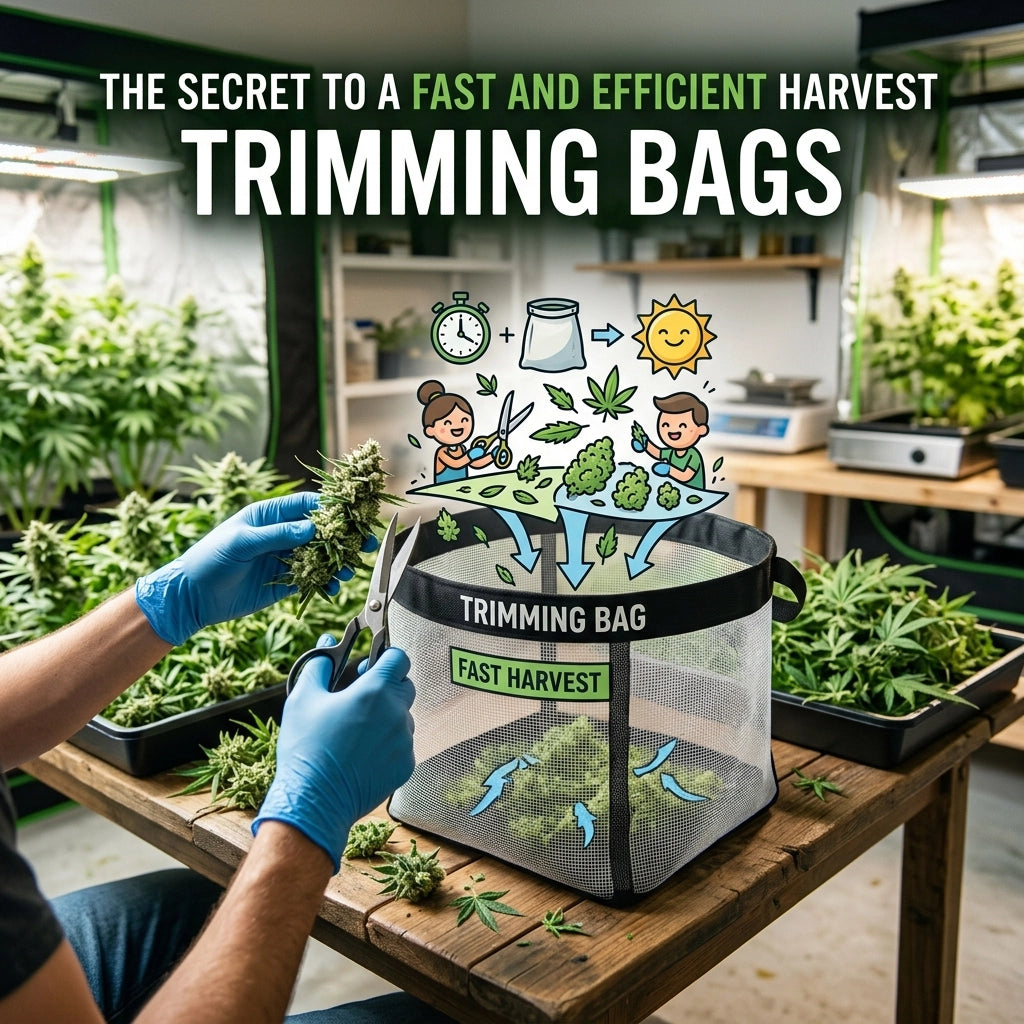
Harvest season is the moment every grower lives for. You’ve spent months monitoring pH levels, fighting off pests, and dialing in your nutrient regimens. But as the excitement of the "chop" fades, reality sets in: you are now facing hours, or even days, of "trim jail."
For many home growers and small-scale farmers, manual trimming with scissors is the ultimate bottleneck. It’s tedious, it leads to hand cramps, and it often feels like you’re spending more time cleaning resin off your blades than actually processing your flower. This is where the trimming bag comes in: a tool that has quietly become the "secret weapon" for growers who value their time as much as their harvest.
At Perfect Gardens, we are all about efficiency. We want you to get the best results with the least amount of unnecessary struggle. In this guide, we’re going to break down why trimming bags are a game-changer for dry trimming, how they compare to traditional scissors, and the steps you need to take to ensure your flower stays top-shelf while saving you hours of labor.
What Exactly is a Trimming Bag?
A trimming bag: like the popular systems from Bubble Magic: is a blade-free, hand-powered dry trimming device. Unlike expensive electric trimmers that use heavy metal blades to "hack" at your buds, a trimming bag uses physics and friction.
The bag usually features a collapsible, multi-chambered design with a specially engineered internal mesh grate. By placing dried material inside and using specific rotational movements, the excess fan leaves and "sugar leaves" are gently knocked off the flower and sifted through the mesh into a collection area.
The beauty of this system is its simplicity. There are no motors to burn out, no blades to sharpen, and no electricity required. It’s a portable solution that can process pounds of flower in the time it would take you to hand-trim a single ounce.

Trimming Bags vs. Manual Scissors: The Real Comparison
Most growers start with a pair of spring-loaded scissors. It’s the traditional way. But is it the best way? Let’s look at the breakdown.
1. Speed and Throughput
Manual trimming is a slow process. On average, a fast trimmer might process one pound of flower in 6 to 10 hours, depending on the density and "leafiness" of the strain.
In contrast, a trimming bag can process up to 2 pounds of flower in about 5 minutes. If you’re a hobbyist with a few plants, you might save an entire weekend. If you’re part of an Army of Growers with a larger canopy, the time savings are exponential.
2. Physical Strain
"Trim jail" isn’t just a metaphor. Repetitive strain injury (RSI) and carpal tunnel are real risks for growers who spend days squeezing scissors. Trimming bags use large-muscle movements: swinging and rotating: which is far less taxing on the joints and tendons in your hands and wrists.
3. Preservation of Trichomes
The biggest argument against machine trimmers is that they "beat up" the buds and knock off the trichomes (the resin glands where the potency lives). While high-speed electric trimmers can be aggressive, the trimming bag is surprisingly gentle. Because it relies on the flower tumbling against itself and a soft mesh, the "agitation" is controlled by you. If you’re gentle, the trichomes stay largely intact on the bud, and the ones that do fall off are collected at the bottom as high-quality kief: not lost to the floor or the blades of a machine.
4. The "Hand-Finished" Look
Scissors will always win on aesthetics. If you want that perfectly manicured, "competition-grade" look where every single leaf is surgically removed, you’ll likely still need scissors for a final touch-up. However, the trimming bag gets you 90-95% of the way there. Many growers use the bag for the bulk of the work and then spend 30 seconds per ounce "hand-finishing" the prize buds.

Caption: A side-by-side comparison of a hand-trimmed bud versus a bag-trimmed bud, showing the high-quality results achievable with the bag method.
The Secret to Success: It’s All in the Dry
If you take away one thing from this article, let it be this: Trimming bags only work if your material is properly dried.
If your flower is still "green" or holds too much moisture, the leaves will be flexible and "leathery." They won't snap off; they’ll just bend and stay attached, leading to a frustrated grower and a messy bag.
For the trimming bag to work effectively, the outer leaves need to be brittle enough to snap when agitated. We recommend a "slow dry" in a controlled environment (like those found in our Grow Tents). You’re looking for that "snap" in the smaller stems, while the core of the bud still retains enough moisture to keep its structure. This delicate balance ensures the leaves fall away while the bud remains solid.
How to Use a Trimming Bag: Step-by-Step
Using a trimming bag is an art form. It’s not just about shaking it like a polaroid picture; it’s about the "tumble."
- Prepare the Material: Remove the large fan leaves by hand before drying. Once the plant is dry, buck the buds off the main stems. You don't want large sticks in the bag, as they can poke the mesh or damage the flowers.
- Load the Bag: Fill the bag approximately halfway. Overfilling prevents the buds from tumbling, which is how the trimming actually happens. Underfilling is less efficient but doesn't hurt the quality.
- The "Flip and Spin": Most bags have handles on the sides and ends. You’ll want to rotate the bag in a circular motion, allowing the buds to slide across the internal mesh screen.
- The Sift: After about 30-60 seconds of tumbling, give the bag a few vertical shakes. This helps the detached leaves (the "trim") fall through the mesh into the collection chamber.
- Check Your Progress: Open the bag and inspect. If the buds still look a bit "shaggy," zip it back up and go for another round. Usually, 2 to 3 minutes of total work is all it takes.
- Collect the Kief: Don't forget to check the very bottom of the bag. The fine mesh often captures high-purity resin glands that have separated during the process.
For those who want to see this in action, we highly recommend checking out our Grow Help Videos for visual demonstrations of post-harvest techniques.
Post-Trim: Storage and Humidity
Once your flower is out of the bag, it’s ready for the curing phase. Even though the bag is fast, you shouldn't rush the cure. This is when the chlorophyll breaks down and the flavor profile (terpenes) truly develops.
Because the trimming bag requires a slightly "drier" state to work perfectly, your buds might be a little lower in humidity than you’d like for long-term storage. This is where two-way humidity control becomes essential.

Using Boveda packs in your jars or storage containers will pull the humidity back up to that "sweet spot" of 62%, ensuring your flower stays fresh and potent for months.
Maintenance and Longevity
One of the reasons we recommend trimming bags over electric machines is the ease of maintenance. Electric trimmers require hours of scrubbing with isopropyl alcohol to remove the "schmoo" from the blades and motors.
With a trimming bag, you simply turn it inside out after your session and brush it down. If it gets particularly sticky after a large harvest, a quick wipe with a cloth dampened with a little alcohol is usually all it takes to get the mesh back to original condition. Because it's collapsible, you can store it in a drawer or on a shelf, which is a huge plus for growers working in tight spaces.
Is a Trimming Bag Right for You?
While we love the efficiency of these bags, they aren't for everyone.
- The Trimming Bag is for you if: You have more than a few plants, you want to save time, you prefer dry trimming, and you don't want to spend $2,000+ on a commercial electric trimmer.
- The Trimming Bag is NOT for you if: You insist on "wet trimming" (trimming immediately after chop), or if you are a "perfectionist" who enjoys the meditative process of hand-trimming every single flower for 10 hours straight.
The fact of the matter is that as you scale your garden, your time becomes your most valuable nutrient. Spending three days trimming is three days you aren't spending planning your next cycle or optimizing your nutrient regimens.

Caption: A grower happily holding a bag of perfectly processed flower, highlighting the stress-free nature of the trimming bag harvest.
Final Thoughts
At Perfect Gardens, we believe in "Work Smarter, Not Harder." The trimming bag is a perfect embodiment of that philosophy. It bridges the gap between the painstaking slowness of scissors and the aggressive nature of electric machines. It gives you back your time without sacrificing the quality of your hard-earned harvest.
If you have questions about whether your specific strain or setup is a good fit for a trimming bag, don't hesitate to contact us. We’ve helped thousands of growers dial in their harvest workflow, and we’d love to help you get out of "trim jail" for good.
Happy harvesting!


Leave a comment
This site is protected by hCaptcha and the hCaptcha Privacy Policy and Terms of Service apply.