
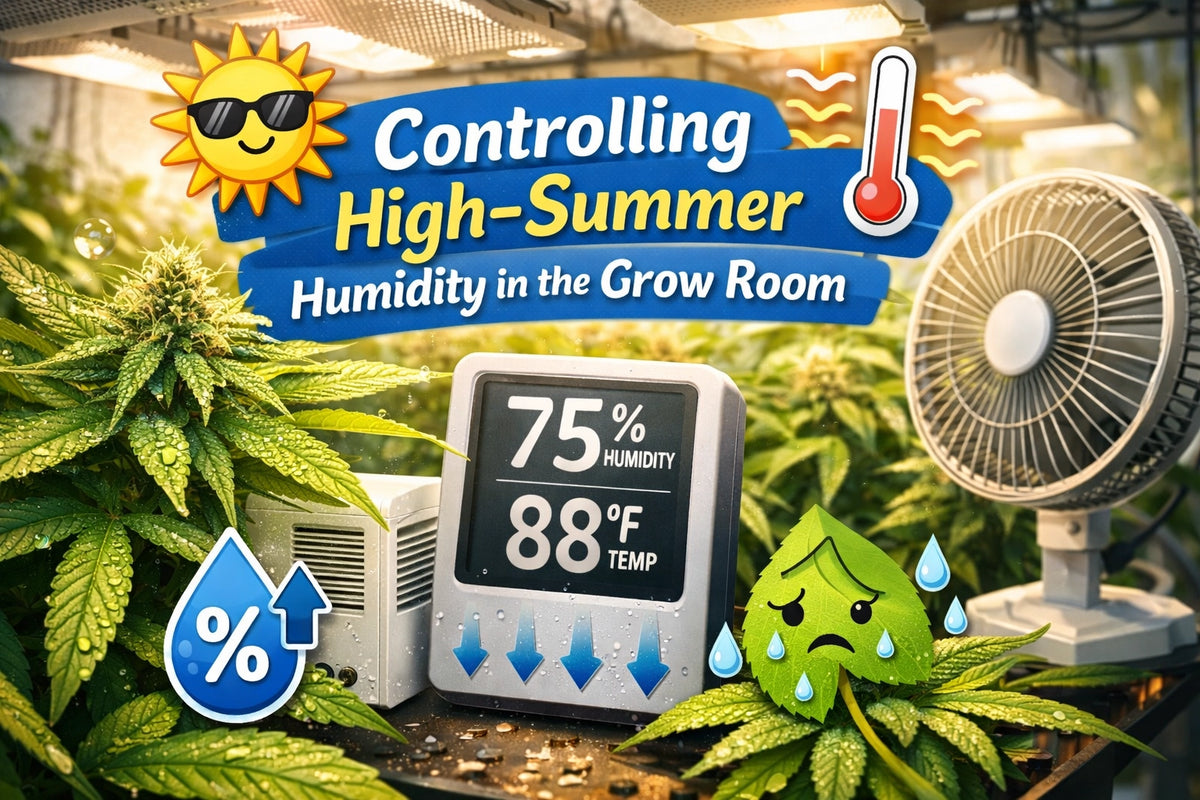
When July hits, the game changes for indoor growers. It’s one thing to manage a grow room when it’s a crisp 60 degrees outside, but when the "Dog Days" of summer arrive, bringing 90-degree heat and 80% outdoor humidity, your indoor gardening setup is put to the ultimate test.
At Perfect Gardens, we see the same thing every year: growers struggling to keep their environment stable while the external world is trying to turn their grow tent into a literal sauna. Managing humidity isn't just about comfort; it’s about the science of plant transpiration and preventing the dreaded "bud rot" that can ruin a harvest just weeks before the finish line.
The fact of the matter is that summer humidity requires a tactical approach. You can’t just throw a fan at the problem and hope for the best. You need to understand the relationship between temperature, moisture, and how your equipment works together to maintain a perfect Vapor Pressure Deficit (VPD).
The Science of Summer Humidity: Why It Spikes
To control humidity, you first have to understand why it’s climbing. In the summer, air is warmer. Basic physics tells us that warm air can hold significantly more water vapor than cold air. When that warm, moist air from outside gets pulled into your grow space via your intake fans, it brings all that moisture with it.
Furthermore, your plants are active contributors to the problem. Through a process called transpiration, plants pull water from the root zone and release it through their leaves as water vapor. In high temperatures, plants often transpire faster to try and cool themselves down, creating a feedback loop where the room gets hotter, the plants sweat more, and the humidity skyrockets.
Understanding VPD (Vapor Pressure Deficit)
We talk about VPD a lot here because it is the single most important metric for plant health. It measures the difference between the amount of moisture in the air and how much moisture the air could hold when saturated.
In the high heat of July, if your humidity is too high, the "deficit" is too small. The air is already full of water, so the plant can't "evaporate" its own moisture into the air. This leads to nutrient transport issues (calcium deficiency is common here) because the plant isn't "drinking" from the roots. On the flip side, if it’s too hot and the humidity is too low, the plant transpires too fast and starts to wilt or burn.
Finding that "Sweet Spot" in July is the challenge. If your room is 85°F, you actually need a slightly higher humidity (around 60-65%) to keep the VPD in range for veg, but that same humidity in the flowering stage is a recipe for mold.

The Big Debate: Dehumidifier vs. AC Balance
This is where most growers get stuck. Do you buy a bigger AC or a bigger dehumidifier? The answer depends on your specific indoor gardening setup, but there are some hard truths you need to face.
The Dehumidifier Dilemma
A dehumidifier is essentially a specialized air conditioner that doesn't vent its heat outside. It pulls moisture out of the air, but it exhausts hot air back into the room. In July, adding a dehumidifier inside your grow tent is often a disaster. You might drop the humidity by 10%, but you’ll likely raise the temperature by 5 to 10 degrees.
If you are going to use a dehumidifier, the best practice is to place it in the "lung room": the room where your tent is located. This allows the dehumidifier to dry the air before it gets sucked into the tent, keeping the heat away from your plants.
The AC Advantage
Air conditioners are naturally dehumidifying. As they cool the air, moisture condenses on the cold coils and is drained away. For many growers, a powerful AC is actually the best "dehumidifier" they can buy.
However, standard window units or portable ACs often struggle to handle the massive moisture load of a full canopy in mid-summer. This is why many professional setups transition to a ductless mini-split. They are more efficient at both cooling and removing moisture without the massive energy spikes of portable units.

Optimizing Your Ventilation and Airflow
If your AC and dehumidifier are working overtime and you’re still seeing 70% humidity, it’s time to look at your airflow. Many growers underestimate how much "micro-climates" affect their plants. Even if your hygrometer says 50%, there could be pockets of 80% humidity deep inside a dense plant canopy.
- Powerful Exhaust Fans: Your fan needs to be strong enough to swap the entire volume of air in your tent every 1–3 minutes. If your exhaust is underpowered, the humid air just sits there, getting thicker and thicker.
- Carbon Filter Maintenance: In the summer, high humidity can actually "clog" the pores of your carbon filter. Moisture gets trapped in the charcoal, reducing airflow and making your fan work harder while moving less air. If you notice a smell or a drop in airflow, your filter might be waterlogged.
- Oscillating Fans: You need air moving over and under the canopy. This prevents moisture from "sitting" on the leaf surface, which is exactly where powdery mildew likes to start.

Cultural Practices to Lower Humidity
Sometimes the best solutions aren't hardware: they're habits. You can significantly reduce the moisture load in your grow room by changing how you manage your plants during the peak of summer.
Strategic Defoliation
Leaves are the "lungs" of the plant, and they are also where the moisture comes from. In the high-summer months, being a bit more aggressive with defoliation (especially the lower third of the plant) can drastically reduce the amount of water being pumped into the air. This also improves light penetration and airflow.
Watering Schedules
Avoid watering your plants right before the lights go out. When the lights turn off, the temperature drops, and the air's ability to hold water decreases. This causes the relative humidity to spike. If your soil is soaking wet at "sunset," you are asking for a 90% humidity spike in the dark. Try watering shortly after the lights come on so the excess moisture can be processed and exhausted while the room is at its warmest.
Space Your Plants
It’s tempting to jam as many plants as possible into a Gorilla Grow Tent, but in July, less is often more. More plants mean more transpiration. Giving each plant a little extra "breathing room" allows your ventilation system to actually do its job.
Advanced Monitoring: Don't Guess, Measure
You can't manage what you don't measure. In the summer, environmental conditions can shift in minutes. A cloud covering the sun or a sudden afternoon thunderstorm can swing your lung room's humidity by 30%.
We highly recommend using a smart controller or a digital hygrometer with an app interface. Being able to check your grow room stats from your phone while you're at work is a lifesaver. Look for systems that allow you to set "triggers." For example, you can set your exhaust fan to kick into high gear only when the humidity hits 60%. This saves electricity and keeps your environment stable.

For more technical breakdowns on setting up these systems, check out our grow help videos.
Common Pitfalls to Avoid
- The "Ice Bucket" Myth: Some growers try to cool their rooms with buckets of ice or "swamp coolers." This is a terrible idea for indoor gardening in the summer. These methods work by adding moisture to the air to cool it. While it might drop the temp a few degrees, it will send your humidity through the roof, creating a breeding ground for mold.
- Over-Cooling: If you blast your AC too hard, you might drop the leaf temperature so low that the plant stops transpiring entirely. This can lead to "over-watering" symptoms because the plant isn't using the water in its pots.
- Ignoring the Lights-Off Period: Most mold issues happen at night. When the lights go off and the room cools down, moisture condenses. If your dehumidifier isn't running 24/7 or isn't programmed to handle the "night shift," you are at high risk.
Final Thoughts: Staying Vigilant
The fact of the matter is that summer growing is a test of your indoor gardening setup and your patience. It seems more like a battle against nature than a hobby sometimes, but the results are worth it. By balancing your AC and dehumidifier, focusing on the lung room, and keeping a close eye on your VPD, you can pull down a top-tier harvest even in the middle of a July heatwave.
If you’re feeling overwhelmed by the heat, don't worry: we’ve all been there. Reach out to the Army of Growers or check out our About Us page to see how we’ve helped thousands of growers dial in their environments.
Stay cool, keep the air moving, and happy growing!


Leave a comment
This site is protected by hCaptcha and the hCaptcha Privacy Policy and Terms of Service apply.