
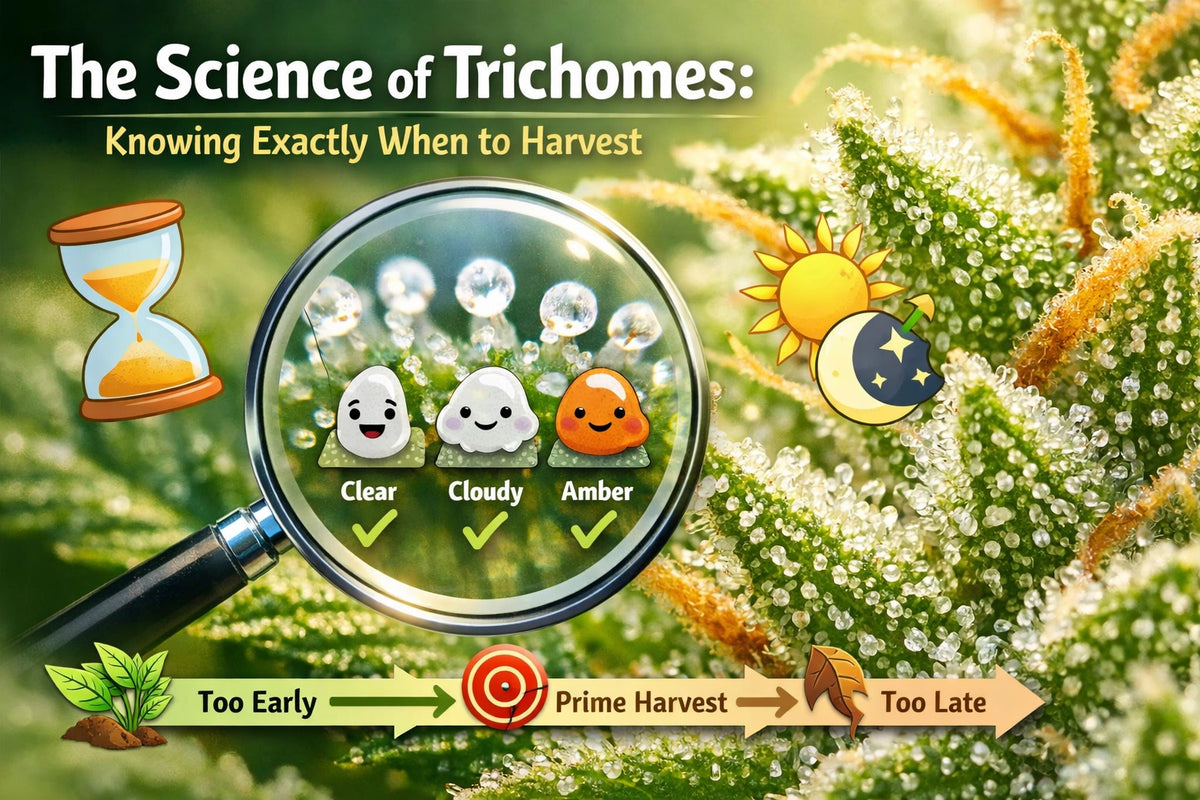
You’ve spent months nurturing your plants. You’ve dialed in the nutrients, managed the light cycles in your Gorilla Grow Tent, and battled through the occasional humidity spike. Now, the finish line is in sight. But here is the problem: if you harvest too early, you lose out on potency and yield. If you harvest too late, you might end up with a crop that makes you feel more sleepy than inspired.
The fact of the matter is that the most reliable way to tell if your plants are ready isn't by looking at the calendar or even the size of the buds, it’s by looking at the trichomes. These microscopic resin glands are the chemical factories of the plant, and their appearance tells a very specific story about the cannabinoids inside.
What Are Trichomes, Anyway?
Before we dive into the colors, let’s talk about what we’re looking at. Trichomes are the tiny, mushroom-shaped crystals that cover the flowers and "sugar leaves" of a maturing plant. In nature, they serve as a defense mechanism, producing terpenes to ward off pests and reflecting UV light to protect the plant’s DNA.
For the grower, however, trichomes are all about the "good stuff." They contain the highest concentrations of THC, CBD, and aromatic terpenes. As the plant matures, the chemical composition within these resin heads changes, and these changes are visible under magnification.

The Three Stages of Trichome Maturity
To get a clear picture of what’s happening, you’ll need a jeweler’s loupe or a digital microscope. Looking at the buds with the naked eye is a guessing game, and when it comes to your hard work, guessing usually leads to disappointment.
1. Clear Trichomes: The "Not Yet" Phase
In the early to mid-flowering stage, trichomes appear like tiny glass pins. They are translucent and clear. At this point, the resin heads are still filling up with precursors to cannabinoids.
The fact of the matter is, if you harvest now, the potency will be incredibly low. The high: if there is one at all: tends to be "speedy" or can even cause headaches because the THC hasn't fully synthesized. It’s a common mistake for beginners to get excited when they see the first "frost" on their plants and chop too soon. Be patient. Clear means wait.
2. Cloudy/Milky Trichomes: Peak THC
As the plant reaches the peak of its life cycle, those clear heads will begin to turn a milky, opaque white. This "cloudiness" is actually a visual signal that THC levels have reached their maximum.
Harvesting when the majority (about 90%) of your trichomes are milky will give you the most "true-to-strain" effect. This is generally associated with a more energetic, cerebral, and uplifting high. The terpenes are also at their most pungent during this stage, meaning your flavor and aroma will be at their absolute best.
3. Amber Trichomes: The Sedative Shift
Eventually, the milky white will start to turn a golden or amber hue. This isn't just a color change; it’s a chemical transformation. Amber color indicates that the THC is beginning to degrade into CBN (Cannabinol).
While some degradation might sound bad, it’s actually a desired trait for many. CBN is known for its heavy, relaxing, and sedative properties. If you’re looking for "couch-lock" or a harvest that helps with sleep, waiting for a higher percentage of amber is the way to go.
Customizing Your Harvest: The Ratio Strategy
It seems more like an art than a science once you realize you can "customize" the effects of your flower by choosing the exact moment to harvest. Very few growers harvest when 100% of trichomes are one color because plants don't mature perfectly evenly. Instead, we look for ratios.
- The Uplifting Harvest: 10% Clear, 90% Milky. (Maximum THC, minimum sedation).
- The Balanced Harvest: 10-20% Amber, 80-90% Milky. (Strong potency with a "rounding off" of the edges).
- The Heavy Hitter: 30-50% Amber, 50-70% Milky. (Deep relaxation, great for nighttime use).
Caution: Letting more than 50% of your trichomes turn amber is generally not recommended unless you specifically want a very lethargic effect. Beyond this point, the plant is essentially over-ripening, and you risk losing the complex terpene profiles that give your strain its unique character.
Secondary Indicators: Pistils and Calyxes
While trichomes are the gold standard, you should also look at the overall "body language" of the plant.
- Pistil Color: Those white hairs (pistils) that stick out of the buds will eventually turn orange, red, or brown. When about 70-90% of them have changed color and curled inward toward the bud, you are in the harvest window.
- Calyx Swelling: The calyxes are the "pods" that hold the pistils. As the plant nears the end, these will swell up and look "fat" or pregnant. This gives the bud its final weight and density.
If your trichomes are cloudy but your pistils are still 50% white and standing straight up, the plant might still have a few days of "bulking" left to do. For more visual examples of this, check out our Grow Help Videos.
Pre-Harvest Preparation: The Flush
As you see those trichomes transition from clear to cloudy, it’s time to think about the final "flush." Flushing involves watering your plants with plain, pH-balanced water (or a specialized flushing agent) to help the plant use up its remaining internal nutrient stores.

Using something like FoxFarm Bushdoctor SledgeHammer during this phase helps rinse out excess salt buildup in the root zone. This is a critical step because trapped salts can lead to a harsh smoke and a "chemical" aftertaste. We usually recommend starting this process 1-2 weeks before your planned harvest date based on your trichome observations.
Tools of the Trade
You can't do this with the naked eye. To get the "scientific" accuracy needed for a perfect harvest, you need magnification.
- Jeweler’s Loupe (30x-60x): Cheap, portable, and effective. It takes a little practice to keep your hand steady enough to see the resin heads, but it’s a staple for every grower.
- Digital Microscope: These can plug into your phone or computer. They provide incredible detail and allow you to take screenshots so you can compare progress day by day.
If you're unsure about what you're seeing, join the Army of Growers. It’s a community where you can share photos and get feedback from experienced cultivators who have seen thousands of harvests.
Post-Harvest: Don't Let the Resin Go to Waste
Once you've made the cut, the work isn't quite over. How you handle the buds after harvest determines if those trichomes stay intact or fall off.
For those processing larger amounts or looking to create concentrates, tools like the Bubble Magic Dry Trimming Bag can make the process significantly faster without destroying the integrity of the flower.

After trimming, the drying and curing process begins. This is where the chlorophyll breaks down and the terpenes truly stabilize. To protect those precious trichomes during storage, maintaining a steady humidity is non-negotiable.

We always recommend using Boveda 62% humidity packs in your curing jars. If the buds get too dry, the trichomes become brittle and fall off (becoming "kief" at the bottom of the jar). If they stay too wet, you risk mold. These packs ensure your hard-earned harvest stays in that "sweet spot" of 62% relative humidity.
Final Thoughts
Harvesting is the most rewarding part of the journey, but it’s also the most nerve-wracking. The fact of the matter is that the plant will tell you when it’s ready: you just have to know how to listen.
By focusing on the science of trichomes rather than a fixed date on the calendar, you take control of the potency, flavor, and effect of your medicine. It doesn't matter if you're growing in a high-end Gorilla Grow Tent or a simple outdoor setup; the biology of the trichome remains the same.
Take your time, use your magnification tools, and wait for that perfect mix of milky and amber. Your future self will thank you when it’s time to finally enjoy the fruits of your labor. If you have more questions or need specific advice on your setup, feel free to contact us anytime. Happy growing!



Leave a comment
This site is protected by hCaptcha and the hCaptcha Privacy Policy and Terms of Service apply.